





A Day Trip to the Living Root Bridges of Riwai Village
The village of Riwai sits quietly in the East Khasi Hills of Meghalaya, a short detour from Cherrapunjee that leads into a landscape of bamboo groves, wet sandstone cliffs, and the most photographed living root bridges in Northeast India. For travellers arriving from Sydney or Melbourne, the destination is something genuinely rare: an engineered ecosystem where the Ficus elastica tree has been trained over generations to span rivers and form footpaths strong enough to carry a small village. Riwai is the easiest place in the region to see this craft without committing to a multi-day trek, which makes it a favourite for visitors who want the reward of a real adventure on a single-day itinerary.
Australian travellers often compare the experience to walking through parts of the Daintree or the Wet Tropics of North Queensland, but the scale and texture of Meghalaya's rainforest are their own thing. The air carries the smell of damp moss and cardamom, the undergrowth hides wild orchids, and the rivers below the bridges run cold and brown with monsoon silt. Cherrapunjee and Sohra are commonly used as base camps, and the road from either town to Riwai takes roughly an hour by car.
A typical day trip starts after an early breakfast, allowing the climb down to be done in cooler morning light and leaving enough margin to return before the afternoon fog settles over the ridge. Most visitors spend three to four hours on the trail, then drive back through pine forests that look more like the highlands of Victoria than the tropics of South Asia. With the right footwear and a patient local guide, it is one of the most rewarding single-day outings available in the country.
Getting to Riwai from Cherrapunjee
The road from Cherrapunjee to Riwai winds past limestone quarries, small roadside markets, and a patchwork of areca nut plantations before dropping into the valley. Travellers based in town usually depart around eight in the morning, after a breakfast of rice, eggs, and chai, and meet a local guide at the trailhead. The drive is short but the road can be rough during the monsoon, so shared jeeps and small SUVs are the usual choice.
If you are coming from further afield, the regional airports of Guwahati and Shillong are the usual gateways, with Shillong sitting at almost two thousand metres and offering some of the clearest mountain views on the approach. Many Australian visitors break their journey in Singapore or Kuala Lumpur before continuing on to Kolkata or Guwahati, which gives them a chance to recover from the long-haul flight before tackling the steep descents of the Khasi Hills.
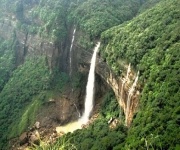
For travellers who want the day trip as part of a longer holiday, several operators arrange guided transport from Cherrapunjee along with a Khasi home-stay in the surrounding villages. A useful option is to book this seven-night itinerary, which folds Riwai into a wider route through Mawsmai Cave, the Nohkalikai Falls, and the surrounding valleys.
Walking down to the living bridges
The trail to the root bridges begins behind a row of bamboo houses, where a small entry fee is collected and a local caretaker explains the etiquette of the descent. The path is well-maintained in the dry months but turns slick and muddy between June and September, when the rain can dump several metres of water on the region in a single week. Stairs cut into the rock and short concrete sections appear at the steepest points, making the climb manageable for reasonably fit visitors.
The walk down takes roughly forty minutes and passes through secondary forest that has been lightly harvested for bamboo and firewood. Birdlife is dense here, with laughingthrushes, barbets, and the occasional hornbill calling from the canopy. The trail then opens onto a clearing above the Umshiang river, where the first glimpse of the root bridges becomes visible across the water.
Most Australian visitors find this descent easier than expected, because the gradient is broken by frequent rest spots and the steps are designed for village foot traffic. Walking poles help anyone with knee problems, and lightweight sandals with grip are common among locals who use the path daily. The return climb is the harder direction, so most groups pause at the bridge for lunch before heading back up.
The bridges of Riwai village
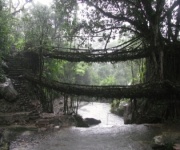
Riwai is home to several living root bridges within walking distance of each other, with the most famous being a double-decker formation that took the community around fifteen years to cultivate. The upper layer is wide enough for two people to walk side by side, while the lower layer forms a natural arch over the river during the dry season. Both are still actively used by villagers crossing to their fields, and it is common to see women carrying baskets of ginger or firewood across the structure.
What makes the bridges special is that they are alive. The aerial roots of the Ficus elastica have been threaded through hollowed betel nut trunks and guided across the riverbed using bamboo scaffolding and patient redirection. Over decades, the roots thicken, fuse with the supporting trunks, and become stronger than the surrounding stone. The bridges can be crossed safely by small groups, though locals discourage jumping or shaking them, since each new stress requires the structure to adjust.
Visitors are asked to walk in single file during busy periods and to avoid standing on the bridge for long stretches, as the structure continues to grow in response to foot traffic. The double-decker at Riwai sits roughly twenty metres above the riverbed and offers a clear view of the water and the secondary growth along the banks.
Khasi village culture and local treats
The villages around Riwai are predominantly Khasi, a matrilineal community whose language and customs differ from much of the rest of Meghalaya. Property and family names pass through the mother's line, and women often hold key positions in village councils and trading. Visitors who stop at a home-stay for tea are likely to be served inside a low-ceilinged kitchen where bamboo baskets are stacked against the wall and a clay stove provides most of the warmth.
Food in the villages centres on rice, smoked pork, fermented soybean, and seasonal greens, often finished with fresh ginger and a small bowl of fish broth. The sweet side of the local kitchen is less famous than the savouries, but it deserves attention. Anyone interested in the regional dessert traditions should read a guide to the lokpob local sweet and other khasi treats, which explains the ingredients behind several of the small sweets sold at roadside stalls in Cherrapunjee and the smaller villages.
Travellers from Brisbane and Perth will find the pace of the village noticeably slower than the cities they are used to, and the rhythm of the day is set by the sound of church bells, the movement of cattle along the lanes, and the steady call to prayer at the local chapel. It is worth taking the time to greet villagers in the local custom of offering both hands, a habit that earns immediate trust and a smile in return.
Weather and the best season to visit
The Cherrapunjee plateau is one of the wettest inhabited places on the planet, with the surrounding hills often recording more than ten metres of rain in a single year. That wetness is what keeps the Ficus roots alive and growing, but it also shapes the experience of a day trip to Riwai. The dry months from October to April bring clearer skies, comfortable walking temperatures, and good visibility for the drive in. The monsoon months turn the trail into a slippery descent through fast-moving streams and occasional rockfalls.
Most Australian travellers plan their visit between November and February, when the days are cool enough for a four-hour walk and the evenings are mild at the higher altitudes. Humidity rises sharply in March and April, while the early monsoon in May can still allow for a visit if the rain does not arrive too early. Tour operators keep a close eye on the weather and will sometimes shift the itinerary to a nearby cave system if the descent becomes unsafe.
Layers are essential at any time of year, as the temperature can swing from warm and humid at the bridge to a chilly fog at the trailhead by late afternoon. Light rain gear, a change of socks, and a small dry bag for cameras will keep most of the day comfortable, especially for visitors used to the drier climate of Western Australia.
Practical tips for travellers from Australia
Australian passport holders currently require an Indian visa or e-visa for entry, and most travellers arrange this online before departure. Currency can be exchanged at the major airports, but small Indian rupee notes are useful for entry fees and tips at the village. English is widely spoken across Meghalaya, which makes the day trip much easier for first-time visitors to India.
Health preparation matters: a consultation with a travel doctor in Melbourne or Sydney is recommended for vaccinations and advice on altitude sickness, since Shillong sits at close to two thousand metres. Pack light, breathable clothing for the descent, sturdy hiking shoes with grip, and a refillable water bottle, since spring water along the trail should still be filtered if you have a sensitive stomach. Travellers who plan to extend their stay can compare the bridges on offer in the area with the table below before deciding how long to spend in the region.
| Bridge or site | Walk time from trailhead | Difficulty | Best for |
|---|---|---|---|
| Riwai double decker | About 45 minutes down | Moderate | Iconic photo opportunity, two-tier structure |
| Single root bridge nearby | About 30 minutes down | Easy | Travellers with limited time or younger children |
| Secondary crossing at Umshiang | About 25 minutes down | Easy to moderate | Quieter visit, less foot traffic |
What to pack for the day
- Lightweight hiking shoes with strong grip, since the descent is steep and the steps can be slick even in the dry season
- A small daypack with two litres of water and electrolyte sachets for the climb back up
- A rain jacket or poncho, because the weather can shift quickly over the ridge
- Camera or phone in a dry bag, as humidity at river level can fog lenses within minutes
- A change of socks and a light long-sleeve shirt for the cooler evening drive back to Cherrapunjee
- Small notes of Indian currency for the entry fee, the guide, and any snacks bought at the village stalls
Etiquette and local customs in the Khasi Hills
- Always greet elders first and use the local custom of offering both hands when shaking, which is a sign of respect in Khasi culture
- Ask before photographing villagers or their homes, particularly when children or ceremonies are involved
- Avoid crossing the bridges in groups larger than four or five people, and never jump or shake them, as they continue to grow in response to foot traffic
- Tobacco and alcohol are restricted in many village areas, so check with your guide before lighting up at the trailhead
- Carry any rubbish back down with you, as the village has no formal waste collection and the river is shared with downstream communities
For travellers ready to turn a single day trip into a longer exploration, the seven-night itinerary on offer from India Beacons Sojourn combines Riwai with the region's best-known waterfalls, limestone caves, and a Khasi home-stay experience. Reach out to the team through the contact page to confirm dates, ask about group sizes, and arrange a guide who speaks English well. Once the monsoon is past and the skies clear over the ridge, Riwai is one of those rare places that stays with you long after the flight home to Australia.