




Eco-Parks and Nature Reserves Around Sohra: A Traveller's Guide
Sohra, the alternative name for Cherrapunjee in the Khasi language, sits among some of the wettest hillsides on Earth. The town and its surroundings belong to a network of protected forests, community reserves, and eco-zones that protect a startling variety of plants, insects, and birds. For travellers stepping off a long flight from Sydney or Melbourne, the area offers a very different kind of wilderness experience to the arid outback or the temperate rainforests of Tasmania.
What makes the Sohra region stand out is the way conservation works hand in hand with daily life. Khasi villages have managed stretches of forest for generations, planting living root bridges across streams and protecting groves that feed local springs. Modern eco-parks now sit alongside these older traditions, creating landscapes where visitors can walk, climb, and explore without disturbing the delicate balance that defines the Khasi Hills.
The Ecological Setting Around Sohra
The East Khasi Hills district sits at the junction of Indo-Burmese biodiversity hotspots, where orchids, rhododendrons, ferns, and tropical hardwoods thrive in heavy monsoon moisture. The cliffs around Sohra drop more than a thousand metres into the Bangladesh plains below, creating microclimates within walking distance of each other. The plateau above holds subtropical evergreen forest, while the gorges below shelter warm, humid pockets full of palms and lianas.
A handful of small reserves and eco-parks ring the town, protecting waterfalls, caves, and old growth. The Meghalaya state forest department manages several of the larger tracts, while community-led groups look after smaller heritage groves and root bridge corridors. Travellers who arrive from Brisbane or Adelaide, where eco-tourism has grown steadily over the past decade, often find this blend of official and grassroots conservation unexpectedly accessible.
Birdwatchers tend to be the most enthusiastic visitors. The forests near Sohra host laughingthrushes, flycatchers, and the endemic Mrs Hume's pheasant, along with a long list of hornbill species. Some eco-zones are also home to the rare and sometimes elusive Hoolock gibbon, the only ape found in India.
Mawsmai Cave and the Surrounding Limestone Forests
Mawsmai Cave is the best known natural attraction close to Sohra town, and it sits inside a small but ecologically rich protected forest. The cave itself is a short walk through dripping limestone passages, lit by shafts of daylight that filter through sinkholes above. Beyond the cave entrance, a short trail leads into forest where the limestone bedrock forces unusual growth patterns, and fig trees send roots down through cracks in search of moisture.
The forest around Mawsmai is a fine example of a working eco-park. Boardwalks, labelled plants, and a small interpretation centre help visitors identify local flora, while strict rules keep the cave interior free from litter and graffiti. Rangers stationed at the entrance check permits and explain the cave's geology, including how rainwater slowly sculpts the stalactites and stalagmites that draw most visitors in the first place.
Many travellers combine Mawsmai with a visit to Mawjymbuin Cave, a quieter site a short drive further on. Mawjymbuin holds a striking natural Shiva lingam formation that has drawn pilgrims for centuries, alongside bat colonies and fossil-rich rock walls. Together, the two caves give a useful cross-section of Khasi Hills geology in a single morning.
Nohkalikai Falls and the Eastern Escarpment
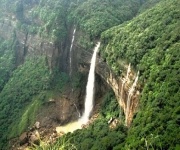
Nohkalikai Falls pours off the rim of the plateau near Sohra, dropping roughly 340 metres in a single thread before disappearing into a forested plunge pool. The falls are now managed within a designated eco-zone that includes a series of viewing platforms, marked footpaths, and an interpretation pavilion. The protected area aims to balance tourist access with the preservation of the cliff vegetation that clings to the misted rock face.
Walking the viewing trail takes visitors through a strip of subtropical forest that includes wild bananas, tree ferns, and orchids growing on branches dampened by constant spray. Monsoon-fed streams cross the path in small bridges, and the air carries the mineral scent of fresh limestone. Bird activity is high in the early morning, with minivets and bulbuls common along the edges of the cliff.
The eco-zone also includes a small museum that explains the legend of Nohkalikai, the local woman whose name means "leap of Ka Likai", along with geological notes on how the falls formed. Travellers who want to extend the walk can follow a steeper trail toward the base of the gorge, though this route is best left for the drier months between November and February, when the steps are less slippery and the rock faces less hazardous.
Living Root Bridges Within Community Reserves
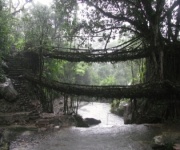
The living root bridges of the Khasi Hills are among the most distinctive ecological features anywhere in India. These bridges are grown over decades from the aerial roots of strangling fig trees, guided across streams by generations of villagers. Several of the most famous examples lie within community reserves that protect both the bridges and the surrounding forest catchments.
Double Decker Root Bridge at Nongriat, a few hours trek from Sohra, is the best known. The walk down to it passes through old growth forest and small Khasi hamlets, with the reserve rules requiring visitors to stick to the marked trail. Other bridges at Mawsaw, Ritymmen, and Umnong offer quieter alternatives, and each is supported by a local committee that collects a small entry fee and maintains the surrounding groves.
These reserves work because the communities themselves have a say in how the land is managed. Tree felling is restricted, streams are kept clean for drinking water, and the fig trees that form the bridges are protected as living infrastructure. Australian hikers used to the demanding trails of the Australian Alps often appreciate the gentle gradients here, though the descent into each valley is steeper than it looks on a map.
Thangkharang Park and the Wider Khasi Hills
Thangkharang Park sits on a ridge to the south of Sohra, with sweeping views over the Bangladesh plains on a clear day. The park functions as a botanical reserve, with marked trails through a mix of native trees, bamboo groves, and ornamental plantings laid out during the colonial period. A small entrance fee supports upkeep, and a handful of gazebos offer shelter during the frequent rain showers.
The park is also a useful starting point for longer walks into the surrounding hills. Trails lead toward the Mawsmai and Mawjymbuin cave systems, as well as toward several smaller eco-zones maintained by Khasi villages. Travellers who want a quieter experience often combine Thangkharang with a short trek to a lesser known waterfall, where the only sounds are birdsong and the splash of water on rock.
Away from the park itself, the Khasi Hills support scattered reserves around Mawsynram, Shillong Peak, and the sacred grove at Mawphlang. The Mawphlang Sacred Grove, in particular, has been protected by community custom for centuries and contains old growth forest that has never been logged. Visitors can walk its forest trails with a local guide, who explains the traditions that keep the grove intact.
Practical Travel Tips for Visitors from Australia
A trip from Australia to Sohra takes a bit of planning, as the route typically runs from Sydney, Melbourne, or Brisbane through Singapore or Kuala Lumpur into Guwahati, then onward by road into Meghalaya. Most Australian travellers carry an Indian e-visa obtained online before departure, and a Protected Area Permit is required for certain border stretches of Meghalaya, which can be arranged through tour operators in advance.
Within Meghalaya itself, transport is usually by shared taxi or pre-booked car from Guwahati to Shillong, then onward to Sohra. The road climbs sharply once it leaves the Assam plains, and the final stretch winds through pine forest and small Khasi villages. Travellers who want to skip the multi-step journey can fly into Shillong airport, which receives a handful of daily connections from Indian hubs and is roughly a two-hour drive from Sohra.
Australian visitors are generally well prepared for the local conditions, since they tend to pack sturdy hiking boots and rain gear for the variable mountain weather. It still helps to carry a printed copy of hotel bookings, as mobile data can be patchy in the more remote valleys.
Eco-Park Essentials to Pack for the Khasi Hills
- A reliable rain jacket and quick-dry trousers, since rainfall averages exceed ten metres a year in parts of the district.
- Sturdy waterproof hiking boots with good grip, especially for the slippery limestone steps near the waterfalls.
- A small daypack with water bottles, energy bars, and a basic first aid kit including blister treatment.
- Headtorch and spare batteries for cave walks where lighting can be unreliable during power cuts.
- Binoculars for birdwatching, as the local hornbill and laughingthrush populations reward early mornings.
Best Windows for Visiting Each Eco-Park
- Mawsmai Cave performs best between November and April, when water levels in the cave passages are lower.
- Nohkalikai Falls reach peak volume in June and July, though heavy mist can obscure the view from the platforms.
- Living root bridge reserves are easiest to walk between October and March, before the heaviest monsoon rains arrive.
- Thangkharang Park is comfortable for most of the year, with clear views typically between November and February.
- Mawphlang Sacred Grove welcomes visitors year round, though morning visits offer the best chance to see wildlife.
For travellers comparing eco-destinations across tropical islands, sustainable tourism resources from other Indian Ocean destinations can offer useful parallels on how small island communities manage fragile ecosystems. The lessons learned in Mauritius around coastal conservation often echo the work being done in the Khasi Hills, where local stewardship remains the strongest form of protection.
Sohra's eco-parks reward travellers who arrive with patience, decent footwear, and a willingness to slow down. The forests, caves, and waterfalls feel less like attractions and more like working landscapes shaped by centuries of careful use. Booking through established operators such as the official Cherrapunjee tours site helps ensure that local communities benefit directly from each visit, and that the protected areas continue to receive the support they need to thrive.