





Sohra morning market: a guide to fresh produce in Cherrapunjee
Australian travellers are no strangers to vibrant food markets. From the bustling corridors of Queen Victoria Market in Melbourne to the weekend stalls at Paddy's Markets in Sydney, we understand that a market tells the story of a place. Long before lunch service begins in the cafes of Adelaide or the craft beer taps flow in Hobart's Salamanca Place, locals are already deep in conversation over crates of just-picked greens.
Half a world away, perched on the edge of one of the wettest plateaus on earth, the small town of Sohra—often called Cherrapunjee—hosts its own version of this ritual. The morning market here is less polished than the showpiece halls of Australia's capital cities, but what it lacks in manicured presentation, it more than makes up for in freshness, altitude, and character.
Arriving before the mist burns off the cliffs, visitors will find Khasi women in woven jainsem wraps arranging pyramids of pineapples, ginger, and forest honey. The market is not a tourist set piece. It is the working heartbeat of the town, where farmers from surrounding villages descend after a pre-dawn walk along misty footpaths to sell what their fields produced the day before.
This guide walks through the rhythm of the market, the produce you can expect to find, how to navigate the stalls respectfully, and how to pair a market visit with the broader natural attractions of the Cherrapunjee region. For anyone mapping out a longer stay, the full Sitemap of the area offers additional points of interest worth weaving into your itinerary.
When the market comes alive
The Sohra market begins in earnest around sunrise, though the first trucks and baskets often arrive well before that. By seven in the morning, the central lane near the police station and taxi stand is already clogged with people. Vendors who have walked down from villages like Mawmluh, Nongsteng, and Sohra itself spread their goods on blue tarpaulins, on low wooden tables, or directly on the raised concrete platforms that line the square.
Australians used to the precise opening times of the Adelaide Showground Farmers' Market or the strict 6am starts at the Brisbane Jan Powers markets might find the Sohra morning slightly chaotic. There are no permanent stall numbers, no printed price tags, and no eftpos terminals. Most transactions are cash, often settled with a quick calculation on a mobile phone or in the buyer's head. The atmosphere is brisk but not rushed; people chat, smoke small hand-rolled beedis, and catch up on family news while a transaction is being weighed.
The market winds down by mid-morning. By eleven, the heavier crates have been packed away and only a few persistent sellers remain. If you want the full effect—the noise, the colour, the crush of bodies—plan to be there between seven and nine. If you prefer a quieter browse with more room to inspect individual pieces, arriving closer to ten gives you a more relaxed hour.
What the stalls offer
The produce at Sohra market reflects the agricultural rhythm of the East Khasi Hills. This is not a market for imported fruit or refrigerated dairy. What you find is grown within a day's walk of the square, often much closer. The seasonal rotation is dramatic, because Cherrapunjee sits at roughly 1,400 metres and receives the full force of both the southwest and northeast monsoons.
Staples to look for on a typical morning:
- Pineapples — smaller, more aromatic than the smooth Cayenne varieties found in Brisbane supermarkets, often sold by the piece rather than by weight
- Oranges and rough lemons — grown on terraced orchards down toward the Bangladesh border
- Ginger and turmeric — fresh, unwaxed, with the soil still clinging to the roots
- Bay leaves and wild peppercorns — foraged from the surrounding forests
- Seasonal leafy greens — mustard, spinach, and several varieties unique to the Khasi kitchen
Many of these ingredients will look familiar to Australian cooks who frequent the weekly farmers' markets along the Victorian coast. The flavour profile, however, is distinct. Sohra ginger carries a sharper heat, and the pineapples have a nearly tropical perfume that disappears within hours of being cut.
Beyond the vegetables: the market's other treasures
While fresh produce is the headline act, the morning market also serves as a clearing house for several non-edible goods that reflect the region's economy. Walking past the fruit sellers, you'll find sections dedicated to bamboo crafts, hand-woven baskets, and bundles of firewood bound with cane. These are practical items, made for use rather than display, but they make excellent souvenirs for travellers heading back to share with family.
Other items worth seeking out:
- Fresh bamboo shoots, peeled and ready for the day's cooking
- Forest honey in reused plastic bottles, dark and intense
- Dried fish and pork, smoked over local woods
- Hand-rolled incense sticks made at nearby convents
- Khasi herbal teas, sold loose by the gram
The honey in particular is worth singling out. Apiaries are perched on cliffsides around Cherrapunjee, and the resulting honey has a smoky, almost malty quality that differs from the lighter Manuka varieties Australians may be used to buying from New Zealand producers. Buy a bottle early in the trip; it travels well in checked luggage.
How to navigate the morning
A few practical pointers make the experience smoother. First, bring small-denomination Indian rupee notes. The nearest ATMs are in the town centre but can run out early in the morning. Second, dress for mud and rain even in the dry season. The path from the main road to the market often becomes slick, and a light rain jacket takes up little room in a daypack.
Bargaining is expected but light. Prices are already close to what the vendor considers fair; aggressive haggling, the sort that might pass muster at the night bazaars of Delhi, will be met with amused resistance. A better approach is to buy multiple items from one seller, which often results in a small discount and a longer conversation.
Language is rarely a barrier. Most sellers in Sohra speak enough English to handle transactions, and younger vendors often switch between Khasi, Hindi, and English with ease. A simple greeting of "Kumno" (good morning) goes a long way. Visitors from Sydney or Perth who have travelled through Southeast Asia will find the social rhythm familiar—polite, curious, and unhurried despite the apparent bustle.
Pairing the market with the region's natural wonders
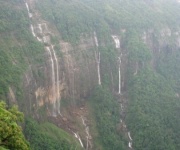
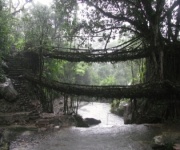
The morning market pairs naturally with a day spent exploring Cherrapunjee's headline attractions. After the stalls close, the limestone hills above the town reveal a chain of caves, waterfalls, and the famous living root bridges. The Mawjymbuin Cave, with its striking natural limestone formations, sits only a short drive from the market square and offers a cool contrast to the morning's crowded lanes. Travellers interested in geology and quiet contemplation often find it a rewarding complement to the social energy of the market. Read about Mawjymbuin Cave's natural pillars before you go.
A market morning followed by a cave or waterfall afternoon is the rhythm most multiday packages follow. Two-night itineraries often include the market on day one, leaving day two for the longer trek to the Double Decker Living Root Bridge at Nongriat. Three-night packages allow time for both, plus a recovery day with a visit to the eco-park or a quiet hour at one of the cliffside viewpoints.
The market itself is a strong reason to time your visit for the cooler months between October and April, when the produce selection is at its peak and the rains have softened but not yet turned the paths to mud. Australians planning a winter escape—particularly those looking to swap a grey July in Melbourne for sunlit highland mornings—will find the climate mild, the air crisp, and the welcome warm.
The morning market in Cherrapunjee is one of those rare travel experiences that rewards the traveller who arrives early, walks slowly, and eats well. For those ready to turn a market visit into a longer retreat, the multi-day packages operated through Cherrapunjee.net cover accommodation at local resorts, guided transfers from Guwahati, and the small logistical touches that make a highland morning feel effortless. Reach out through the booking inquiry form on the site to start planning a stay that begins, as it should, with the first basket of pineapples.