




A Guide to the Rare Orchids of the Khasi Hills
The Khasi Hills of Meghalaya are known for mist-covered ridges, heavy monsoon rain, limestone caves, and living root bridges. They are also home to an impressive orchid flora shaped by cool elevations, humid forests, shaded ravines, and trees covered in moss. Some orchids are familiar garden plants, while others are rarely seen outside their natural habitat.
Orchid watching in this region is different from visiting a conventional flower garden. Many species grow high in tree forks, cling to damp rock faces, or bloom briefly along forest paths. A careful observer may notice delicate flowers only after slowing down and looking closely at bark, moss, leaf litter, and branches above eye level.
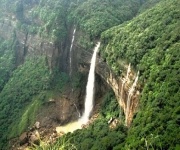
Cherrapunjee, also called Sohra or Cherrapunji, is a useful base for exploring the southern Khasi Hills. Its waterfalls, forest trails, and surrounding villages provide access to varied habitats, although exact orchid sightings depend on season, weather, local conditions, and guidance from people familiar with the area.
The habitats that support Khasi orchids
The Khasi Hills contain a mosaic of habitats rather than one continuous forest type. Evergreen forest, subtropical woodland, pine patches, bamboo stands, steep ravines, and exposed ridges all create different growing conditions. Orchids respond to these small changes in temperature, moisture, shade, airflow, and host trees.
Epiphytic orchids grow on branches and trunks without taking nutrients from their host tree. They collect water and minerals from rain, dust, decaying bark, and organic matter trapped around their roots. Lithophytic species grow on rocks, while terrestrial orchids emerge from soil and leaf litter. A single forest walk can therefore reveal several distinct growth forms.
The wet escarpments around Sohra are especially interesting because rainwater moves quickly down cliffs and gullies, producing damp microhabitats even when nearby slopes appear more open. Forest fragments near villages can also retain valuable plant diversity. Their importance is easy to overlook because the orchids may be scattered and seasonal rather than forming large, visible displays.
Why some species are considered rare
Rarity can mean several things in the Khasi Hills. A species may have a naturally small population, occupy a narrow elevation range, bloom for only a short time, or survive in locations that are difficult to reach. An orchid can also be locally uncommon while remaining more widely distributed elsewhere in northeastern India or the eastern Himalayas.
Habitat loss is an additional concern. The removal of mature trees affects epiphytes, while quarrying, road construction, fuelwood collection, unmanaged tourism, and changes in land use can disturb orchids growing on rock or forest floor. Climate shifts may alter flowering times and moisture patterns, making it harder for pollinators and plants to remain synchronized.
Names can create confusion as well. Orchid identification often depends on flower shape, column structure, lip markings, pseudobulbs, leaves, and sometimes the host plant. A photograph taken from a distance may not be enough for a reliable identification. Local names may vary between communities, and taxonomic names can change as botanists revise classifications.
For that reason, “rare” should not be treated as an invitation to collect. Wild orchids are best appreciated in place, photographed without damage, and reported to local conservation groups or knowledgeable botanists when a significant sighting is made.
Orchids worth looking for
The blue vanda, Vanda coerulea, is among the most celebrated orchids associated with northeastern India. Its blue to violet flowers and patterned sepals make it instantly recognizable when in bloom. It prefers bright, airy conditions and mature trees, but finding one in the wild is never guaranteed. A cultivated specimen should not be assumed to have come from a nearby forest.
Paphiopedilum insigne, often called the Indian slipper orchid, is another remarkable species of the region. Its pouch-shaped flower is adapted to trap visiting insects temporarily, encouraging contact with the reproductive structures. This terrestrial or lithophytic orchid is associated with rocky, forested environments and has faced pressure from habitat disturbance and illegal collection.
Several Dendrobium species may occur across Meghalaya’s forests. Dendrobium nobile produces showy flowers along older canes, while golden-flowered species such as Dendrobium chrysotoxum are valued for their vivid colour and fragrance. Their flowering periods can vary with elevation and weather, so a local guide can be more useful than a fixed calendar.
Other orchids that may interest careful observers include Coelogyne cristata, with pale flowers and a textured lip, and Rhynchostylis retusa, known for dense sprays of fragrant flowers. Aerides odorata, Cymbidium species, Bulbophyllum species, and small Eria orchids add further variety. Some have modest flowers that reward close inspection rather than dramatic first impressions.
| Orchid group | Typical growth habit | What to notice | Suitable observation setting |
|---|---|---|---|
| Vanda | Epiphytic | Broad roots, arching leaves, patterned flowers | Mature trees and open forest edges |
| Paphiopedilum | Terrestrial or lithophytic | Slipper-shaped pouch and mottled leaves | Shaded rocks and forest floor |
| Dendrobium | Mostly epiphytic | Cane-like stems and flowers along nodes | Mossy branches and humid woodland |
| Coelogyne | Epiphytic or lithophytic | Pseudobulbs and pale, often fragrant flowers | Cool, damp forest and rock faces |
| Rhynchostylis | Epiphytic | Long flower clusters and thick leaves | Lowland to mid-elevation trees |
| Bulbophyllum and Eria | Mostly epiphytic | Small, unusual flowers and compact growth | Moss-covered trunks and shaded branches |
The table is a field reference rather than a promise of particular sightings. Orchids may be dormant, hidden above the trail, or flowering several weeks earlier or later than expected. A local name, clear photograph, and record of elevation and habitat can help specialists confirm an observation.
Where to look around Sohra
Forest trails near Cherrapunjee offer a practical starting point because they combine accessible viewpoints with damp woodland, cliffs, and shaded paths. The routes near Mawsmai and nearby limestone landscapes can reveal plants adapted to rock and humid forest, although visitors should stay on established paths and avoid touching plants growing on fragile surfaces.
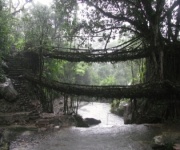
The walk to Nongriat is better known for its living root bridge than for botanical observation, yet the route passes through moist valleys, stream edges, and dense vegetation. The descent and return are physically demanding, and orchids may be easier to notice during a slower ascent when there is time to examine tree trunks and shaded banks.
Mawphlang and other forest areas around the Khasi uplands have a different atmosphere from the wet escarpment. Their cooler woodland, mossy trees, and traditional conservation practices create promising conditions for epiphytes and terrestrial orchids. Access rules differ between locations, so visitors should follow local instructions and avoid entering restricted sacred forest areas without permission.
Orchid watching can also begin in cultivated collections, nurseries, and botanical gardens. These places provide a useful way to learn flower forms before going into the forest. A cultivated orchid with a label can help visitors understand the difference between a Dendrobium cane, a Cymbidium pseudobulb, and the pouch of a slipper orchid, but it should not be used as proof that the same species grows beside a particular trail.
For route planning, accommodation choices, local attractions, and other practical travel information can be reviewed before arranging a Khasi Hills visit. Travel time between viewpoints and villages can be longer than distances on a map because of winding roads and steep terrain.
Timing an orchid-focused visit
The monsoon gives the Khasi Hills their extraordinary greenery, but intense rain can make trails slippery, obscure distant views, and complicate photography. Some orchids respond to the wet season with active growth, while others bloom after rainfall when conditions become brighter and air circulation improves. A visit during or shortly after the rains can be botanically rewarding, provided routes are safe.
The cooler months often offer more stable walking conditions. Clearer skies improve access to forest paths and waterfalls, and lower humidity can make a long excursion more comfortable. However, a dry-season visit may produce fewer fresh flowers in some habitats. Orchid flowering is influenced by elevation, temperature, rainfall, and the previous season’s conditions, so no single month guarantees a complete display.
Early morning is usually the best time for observation. Flowers may look fresher, birds and insects are active, and soft light reveals colour without harsh shadows. Carrying a small notebook is worthwhile because habitat details can be as important as the flower itself. Record the trail, approximate elevation, host tree, leaf form, scent, and flowering stage.
A smartphone macro lens can help with close images, but avoid pressing flowers, moving branches, or climbing to reach an epiphyte. A photograph that includes the whole plant, its flower, and its growing position is generally more useful than a close-up alone.
Preparing for a responsible forest walk
A thoughtful orchid excursion protects the habitat while making the experience safer and more rewarding. Before setting out, check local weather, trail conditions, transport arrangements, and any permissions required for forest or community-managed areas. The following items are particularly useful:
- Lightweight rain protection and a waterproof cover for phones, cameras, and notebooks
- Shoes with firm grip for wet roots, mud, stone steps, and uneven ground
- A small magnifying glass or phone macro attachment for observing flowers without touching them
- Drinking water, basic first-aid supplies, insect protection, and a torch for slow returns
- Binoculars for epiphytes growing above eye level, where climbing would cause damage
Use a local guide when a route crosses community land, sacred forest, steep ravines, or poorly marked paths. Guides can often identify seasonal flowers, explain customary restrictions, and point out orchids that an unfamiliar visitor would miss. Their knowledge also reduces the temptation to leave the trail or search through vegetation.
Do not buy wild-collected orchids from roadside sellers unless the plants are clearly documented as nursery-propagated and legally traded. Never remove a plant, pseudobulb, seed capsule, moss clump, bark section, or host branch. Even a small specimen may represent years of growth and may be part of a much larger ecological relationship involving fungi, pollinators, and the tree on which it lives.
Reading the forest beyond the flower
An orchid sighting becomes more meaningful when its surrounding habitat is understood. Look at the moisture on the bark, the amount of light reaching the plant, the presence of mosses and ferns, and whether the orchid grows alone or in a cluster. These details help explain why one species occupies a particular tree or rock face while another appears a few metres away.
Orchid roots also reveal adaptation. Many epiphytes have thick, pale outer tissues that absorb rain rapidly and protect the inner root. Pseudobulbs store water and nutrients during drier intervals, while leathery leaves reduce moisture loss. Terrestrial orchids may depend heavily on fungi in the soil, especially during early development, making transplantation from the wild particularly destructive.
Pollinators are part of the story too. Fragrance, colour, nectar guides, flower shape, and timing can all attract specific insects or birds. A flower that appears plain to a person may be highly visible or strongly scented to its pollinator. Watching from a respectful distance may reveal bees, moths, flies, or other visitors moving between flowers.
The Khasi Hills are valuable because their orchids are part of functioning forests, not isolated decorative objects. Protecting mature trees, stream corridors, rocky habitats, and community-managed woodland supports many plants at once. Visitors contribute most when they travel carefully, spend time locally, and leave every wild orchid where it grows.
Plan a Cherrapunjee journey around patient observation rather than a guaranteed species checklist. Combine an experienced local guide with suitable footwear, flexible timing, and responsible photography, then explore the forests, waterfalls, caves, and village landscapes that make the Khasi Hills exceptional. Contact the tour team through Cherrapunjee.net to arrange a thoughtful Meghalaya visit and discover its living landscapes at a respectful pace.