





Waterfalls to watch for along the main road to Cherrapunjee
The road to Cherrapunjee winds out of the Meghalayan capital Shillong and begins to climb almost immediately, threading past pine groves, bamboo clusters, and roadside tea stalls before the Khasi Hills open up into one of the wettest landscapes on the planet. Travellers who have flown in from Sydney or Melbourne and landed at Guwahati quickly realise that this single ribbon of tarmac, just over fifty kilometres long, doubles as a moving viewpoint for some of India's most photographed cascades.
Cherrapunjee, also written Cherrapunji and locally called Sohra, holds a celebrated place in the record books for its rainfall. The hills absorb moisture from the Bay of Bengal monsoon and pour it back down in sheets, veils, and thundering columns of water. The main road, signposted in places as the Shillong-Cherrapunjee Highway, gives visitors a ringside seat for this spectacle without requiring a single difficult detour.
Australians tend to arrive curious but well-prepared. Many travellers from Brisbane and Adelaide plan their India trip around the southwest monsoon, packing breathable layers and quick-dry gear rather than relying on heavy umbrellas. The Indian e-visa system makes the paperwork manageable before departure, and Smartraveller, run by Australia's Department of Foreign Affairs and Trade, provides current advisory notes. With flights usually routing through Singapore, Kuala Lumpur, or Bangkok, the journey to Guwahati is straightforward enough to weave into a longer South and Southeast Asia itinerary.
Because the road is the only practical way in for most visitors, every waterfall of note sits within a few minutes' walk of the carriageway or a clearly marked lay-by. That roadside accessibility is part of the appeal. A self-driven scooter, a hired car with driver, or even a shared jeep means you can stop, photograph, and move on without joining a guided excursion.
The highway through one of the wettest places on Earth
The Shillong to Cherrapunjee road climbs from roughly 1,500 metres above sea level at the starting point to a similar elevation at the destination, with several switchbacks that pull the green valleys into view. The tarmac itself is generally in good condition, though monsoon downpours can throw up small landslips that local crews clear within hours. Petrol stations are sparse, so most travellers fuel up in Shillong before setting off.
As the road crests its first ridge, the south-facing slopes drop away into deep gorges. Mist rolls through the valley, the cliffs appear to sweat, and the sound of falling water accompanies the engine note almost continuously. In heavy rain visibility drops to a few metres, which is why many travellers from Australia schedule their trip for the shoulder months when the falls are still full but the air is clearer.
The highway is also a working road used by village communities, so speed limits are low and livestock can appear around corners. Slow driving is rewarded, and some of the most striking cascades sit in plain view from the driver's seat, requiring only a short walk to reach a better vantage point.
Seven Sisters falls at Nohsngithiang
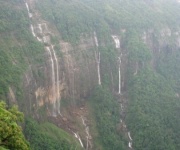
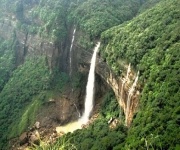
The most famous roadside waterfall in this region is Nohsngithiang, more commonly known as the Seven Sisters Falls. The cliff face here drops roughly 315 metres, and during peak monsoon the water splits into seven distinct streams that tumble side by side, giving the falls their name. From the main road, the cascade appears in the distance as a long, pale curtain hanging against dark rock.
There is a small viewing gallery built into the hillside a few hundred metres off the carriageway, with concrete steps and a railing. The walk is short but the air is heavy with spray, so a waterproof jacket earns its keep. Photographers from Perth and Melbourne frequently time their visit for late morning, when the sun lifts enough to light the streams against the shaded cliff.
Local folklore offers a softer explanation for the seven streams. According to Khasi tradition, the falls represent seven sisters who remain forever separated from a brother on a neighbouring ridge, who appears as a single column of water on a clear day. Guides at the viewing gallery are usually happy to recount the story in English, and several also explain the geology that allows Meghalaya's limestone to hold such tall, near-vertical cliffs.
Dainthlen falls and its local legend
A short drive further along the main road brings visitors to Dainthlen Falls, named after a legendary serpent called Thlen that Khasi tradition says once terrorised the region. According to the story, a man named U Suidnoh lured the creature out of its cave and killed it with the help of villagers, ending its reign. The flat-topped rock near the falls is said to be where the Thlen was slaughtered, and locals still treat the site with a measure of reverence.
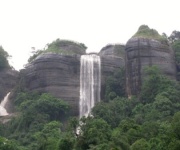
In practical terms, Dainthlen is one of the easiest cascades to enjoy because it sits immediately beside the highway, with parking for a handful of cars and a paved walkway leading to the railing. The water falls in a single white column during the wet months and shrinks to a trickle by late winter. From the viewing platform you can hear the roar and feel the spray without any hiking involved.
A short uphill walk behind the main viewing area leads to a series of smaller cascades and pools, where Khasi families sometimes come for a quiet day out. Australian travellers who plan to base themselves in Cherrapunjee for several days often use Dainthlen as their first stop because it requires the least effort and offers an immediate sense of the landscape.
Wei Sawdong's hidden cascade
A little further along, beyond the village of Mawsmai, the road passes a small signpost for Wei Sawdong. The falls here are less celebrated than Nohsngithiang or Dainthlen, but the setting makes them memorable. The water drops in three stages through bright green limestone, with a deep blue pool at the base that looks almost painted.
Reaching the falls involves a short walk down a path used by local villagers, followed by a clamber over a few rocks. Conditions can be slippery, especially after rain, so closed-toe shoes are essential. The reward is a relatively uncrowded spot where the only sounds are falling water and the occasional call of a hill myna.
Because Wei Sawdong is not always included in standard day-trip itineraries, it appeals to travellers from Sydney and other Australian cities who prefer to wander a little off the obvious route. Photographers in particular like the contrast between the white water and the vivid green moss that clings to the rock during the wet season.
Mawsmai falls near the cave turnoff
Just before the road reaches the main Cherrapunjee township, a short detour leads to Mawsmai Falls, which shares its name with the well-known Mawsmai Cave nearby. The falls are smaller in height than the headline cascades but unusually broad, fanning out across a low cliff in a way that resembles a green curtain.
The viewing area sits at the end of a paved path, and there is a small shelter where guides offer a brief explanation of the surrounding flora. In monsoon, the entire cliff face is alive with water, and visitors can walk behind the curtain through a narrow gap on one side, getting thoroughly soaked in the process. Australian families travelling with older children tend to enjoy this stop precisely because it is safe, accessible, and interactive.
The falls also serve as a useful landmark. Many travellers combine a visit to Mawsmai with the cave and the nearby limestone gardens before returning to their hotel, making it a practical anchor for a half-day plan.
Other roadside cascades worth stopping for
Several smaller falls also break the journey and reward travellers who slow down. Wah Kaba Falls lies only a few kilometres from the town centre, with a deep pool that draws local swimmers during the warmer months. Further along, a series of unnamed drops spill across the rock face during heavy rain, sometimes appearing overnight and disappearing again within a day.
Because the waterfalls of Cherrapunjee respond so directly to weather, no two visits look identical. The locals often say the hills produce a new waterfall for every storm, and while that is poetic licence, the principle holds. Visitors who allow themselves time to stop spontaneously will often find a cascade that wasn't on their map that morning.
For travellers who want to combine several of these stops with cultural visits to nearby villages and the living root bridges, arranging a multi-day itinerary makes sense. The Cherrapunjee three-night itinerary outlines how to link the roadside waterfalls with deeper excursions into the surrounding valleys.
Timing your visit around the monsoon and beyond
The single biggest factor shaping what a traveller sees is the season. The southwest monsoon typically arrives in June and lingers into September, swelling every cascade to its full volume. October and November bring clearer skies, fuller rivers, and the best balance for photography. December through February is dry and cool, with smaller falls and dustier roads, while March and April turn warm and occasionally hazy.
For Australians planning around their own summer holidays, the Indian winter coincides with the Australian summer and offers the most comfortable conditions. Travellers from Brisbane and Perth who are used to driving long distances on rural roads will find the Cherrapunjee highway manageable, though they should factor in the slower pace caused by village traffic and the occasional cattle crossing.
Practical preparations are straightforward. A modest daypack with a waterproof cover, sturdy footwear, and a refillable water bottle covers most roadside stops. Australian travellers should also confirm they hold a valid Indian e-visa and review the Smartraveller advisory page before departure to avoid delays at immigration counters.
Items worth packing for a roadside waterfall day
- A light rain jacket or poncho that fits over a daypack
- Closed-toe shoes with grippy soles for wet rock
- A microfibre towel for spray and the occasional slip
- Dry bags or zip pouches for phone, camera, and documents
- A reusable bottle, since the spring water along the route is generally considered safe but tastes better filtered
Stops that reward even a short visit
- Nohsngithiang Falls for the iconic seven-stream view
- Dainthlen Falls for easy access and a strong local legend
- Mawsmai Falls for the walk-behind-the-water experience
- Wei Sawdong for quieter scenery and a striking blue pool
- Wah Kaba for a relaxed finish close to the town centre
Standing beside the main road with the spray in the air, the engines of passing jeeps fading behind the roar of falling water, it becomes obvious why Cherrapunjee has earned its place on the itinerary of so many travellers heading into Northeast India. The waterfalls here do not require a trek, a permit, or a special vehicle to reach. They simply appear, one after another, beside the same stretch of highway that every visitor must travel. With a little patience, a flexible schedule, and an eye on the weather, the road itself becomes the highlight of the journey.
Bookings and enquiries are handled through the About-us page, where the local team lists contact details and current package options. Reach out today to start shaping a Cherrapunjee trip that suits the season.