




Walking into the Clouds: A Trek to the Remote Village of Nongjrong
High in the East Khasi Hills, where the monsoon clouds roll in low enough to brush the pine tops, sits a settlement most Australian travellers have never heard of. Nongjrong is a Khasi village of stone huts, terraced fields and misty mornings, reached only by a winding track that climbs through subtropical forest and bamboo groves. Those who make the climb are rewarded with one of the last great unspoilt corners of Meghalaya.
The journey appeals to a particular kind of walker. Australians who have already ticked off the Larapinta Trail, hiked through the Blue Mountains or wandered Tasmania's Overland Track often find themselves searching for the next horizon. A multi-day trek to Nongjrong offers exactly that contrast: familiar hills and eucalyptus replaced by rain-soaked jungle, rushing waterfalls and the silent presence of living root bridges woven by hand over generations.
Preparing for the Journey from Down Under
Leaving Brisbane or Melbourne in the middle of an Australian summer feels strangely disorienting when the destination lies in the cooler uplands of north-east India. December and January are the most comfortable months for the trek, when Meghalaya's skies clear and the trails dry out enough to walk without sinking into mud. Flights from Sydney via Singapore or Kuala Lumpur tend to land in Guwahati, with an onward drive into Shillong, the capital of the state, before the real climb begins.
Australians need an Indian visa, which can be arranged online through the e-Visa portal before departure. Travellers from Canberra and Perth often allow a few extra days either side of the trek for jet lag, and the same advice holds for anyone crossing from Adelaide or Hobart. Pack light but warm. Nights at Nongjrong sit close to single digits, even when the day is bright enough for a T-shirt and a wide-brimmed hat.
A good place to start planning the route and the packages on offer is the Cherrapunjee travel website, which lays out two to seven-night itineraries that include the village and the surrounding valleys. Booking through a registered local operator also arranges the inner-line permits that the region sometimes requires, removing one more layer of paperwork from the trip.
The Route Through East Khasi Hills
The drive from Shillong to the trailhead takes a couple of hours and is half the pleasure. The road climbs past Mawkdok Valley, where the highway drops into a green gorge thick with cloud, then snakes on toward Sohra, the old colonial name for Cherrapunjee. From here, the sealed road gives way to a rougher track that climbs steadily toward the village of Laitkynsew, the last major settlement before the final approach.
Most trekkers arrange for a 4WD or a shared jeep to take them as far as possible. Beyond that point, the path narrows to a single foot trail, edged by wild ginger, betel nut palms and the occasional rubber plantation. Guides are essential, both for navigation and for crossing private forest land, which belongs to clans rather than the state.
Australian hikers used to marked routes in Kosciuszko National Park will notice quickly that the trails here are not signposted in any conventional sense. Instead, the path follows stone steps, red earth and cairns, sometimes vanishing under fallen leaves after heavy rain. Local guides read the land the way a bushwalker reads a topographic map, and trust is built quickly over the first hour.
Life in the Khasi Hamlet
Nongjrong itself feels suspended in time. The village spreads across a long ridge, with houses of stone and timber roofed in corrugated iron or split bamboo. Most families belong to the Khasi community, a matrilineal society where lineage, property and family names pass through the mother's line, a custom that often surprises visitors from Australia, where paternal surnames still rule most official paperwork.
Visitors are usually housed in a simple guesthouse or with a host family. Mornings start early, with smoke from cooking fires drifting across the valley and the sound of cattle bells rising from the lower paddocks. Life moves with the seasons: sowing in March, harvesting rice later in the year, and a long quiet stretch in the dry winter months when trekkers are most welcome.
The chapel at the centre of the village is the only large brick building. Sundays draw a small congregation in colourful cotton shawls, and anyone walking past is likely to be invited in for a song, a biscuit and a brief conversation in slow, accented English. Australian travellers accustomed to the secular rhythm of weekend camping will find this gentle piety quietly moving, the kind of communal warmth rarely glimpsed on a fast coastal walk.
Trekking Trails and Living Root Bridges
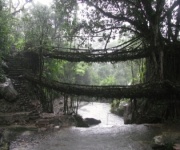
The real reason people walk all the way to Nongjrong sits a few kilometres down the slope. The trail leads to one of Meghalaya's celebrated living root bridges, trained over decades from the aerial roots of the Ficus elastica tree. Unlike the more famous examples near Nongriat, which draw day-trippers from Sohra, the bridge here sees only a handful of visitors each week.
The walk down takes about two hours through dense forest, with slick stones, hanging vines and the steady sound of the Um Ngot river far below. The bridge itself spans a deep gorge, its roots thickened into a sturdy arch that flexes slightly as you cross. There is no handrail, and it is very much part of the experience rather than an obstacle to it.
On the way back, most groups pause at a natural pool for a cold swim, weather permitting. Australians who have spent summers chasing waterfalls in Litchfield National Park or cooling off at Millaa Millaa will recognise that particular pleasure, though the temperature here is closer to an alpine tarn than a tropical creek. Pack a dry bag, a head torch and sturdy boots with proper grip. The trail rewards preparation and punishes the casual.
Local Flavours and Highland Hospitality
Food in the village is hearty, local and largely meat-based, though vegetarians are easily accommodated. Rice, smoked pork, fermented soybean and fresh greens form the backbone of every meal. A typical dinner might include doh khlieh, a pork salad tossed with onions, ginger and the region's famously sharp chillies, alongside a steaming bowl of jadoh, the Khasi rice dish cooked with meat and aromatic herbs.
Tea is poured constantly, sometimes with milk, sometimes with local lemon grass, and always with a small glass of water on the side. Hospitality is unforced. Visitors walking past a cottage in the late afternoon will usually be called in to sit by the fire, share a plate of rice cakes and listen to stories about the village's past, including its quiet role during the years of unrest in the East Khasi Hills and its slower recovery since.
Australian palates, raised on bush tucker festivals from Alice Springs to Broome, will enjoy recognising some of these earthier flavours. There is a kinship between Khasi hill cuisine and the kind of slow, fire-cooked food championed by chefs in inner Sydney and Melbourne, even if the ingredients themselves could hardly be more different.
Practical Tips for Crossing Cultures
A few small courtesies make a big difference. Always ask before photographing people or interiors, particularly inside the chapel. Remove shoes at the doorway of a private home. When offered a drink, take it with both hands; it is a small gesture that signals respect for the matrilineal customs of the household.
Cash is the only reliable option in the village. Carry enough Indian rupees from Guwahati or Shillong to cover guides, homestays and tips, as Australian debit cards often fail to connect in such a remote area. Mobile signal is patchy, with limited coverage from a single tower. Most trekkers switch off and treat the absence as part of the experience, much like a digital detox in the Kimberley or a quiet stretch along the Great Ocean Walk.
Health-wise, a consultation with a travel doctor in Melbourne or Sydney before departure is wise. The recommended vaccinations, plus a basic kit for stomach upsets and blister care, will cover most eventualities. Altitude is not an issue here, but rain is, even in the dry season. A good rain shell, two pairs of quick-dry trousers and a small microfibre towel earn their weight many times over.
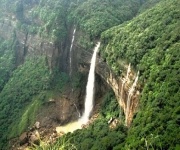
For travellers who fall in love with this corner of Meghalaya, the easiest way to extend the trip is to step back down into Sohra itself. The town offers a gentler pace after days of walking, with waterfalls, limestone caves and the famous "wettest place on earth" claim to explore before the long drive back to Guwahati. The road that once seemed so demanding now feels like the beginning of something rather than the end.
Lock in the trek, choose a homestay and reserve a guided route before the limited winter departures fill up around the Australian school holiday window.