




Living Root Bridges And Regular Bridges In Cherrapunjee
In the rain-soaked hills of Meghalaya, bridges can be built from steel, concrete, stone, timber, or living tree roots. The famous living root bridges of Cherrapunjee, also known as Sohra or Cherrapunji, belong to a rare category of structures that continue growing after they are shaped by people. Their strength develops gradually, through years of care and the natural expansion of rubber fig roots.
A regular bridge is usually designed, engineered, assembled, and opened within a defined construction schedule. It provides a dependable crossing soon after completion, while a living root bridge begins as a long-term community project. Villagers guide flexible roots across streams and ravines, creating a passage that becomes stronger and more integrated with the forest over time.
Comparing these two bridge types reveals different ideas about engineering, maintenance, environmental responsibility, and travel. One represents calculated construction using manufactured materials; the other combines indigenous knowledge with living ecology. Both can be practical, but they serve very different purposes in the landscape around Cherrapunjee.
How Living Root Bridges Are Created
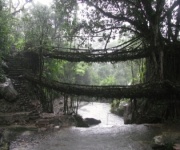
Living root bridges are made primarily from the aerial roots of the Indian rubber fig, or Ficus elastica. This tree can produce strong, adaptable roots that grow across gaps when they are directed along bamboo frames, areca palm trunks, or other temporary supports. Local communities guide the roots toward the opposite bank and patiently wait for them to establish themselves.
The process takes years and sometimes decades. A young bridge may begin as a narrow crossing, while older structures develop several intertwined root layers. As the roots thicken, they form a flexible but remarkably durable platform. Stones, soil, and smaller roots may fill spaces in the walkway, creating a surface suitable for walking.
This method depends on close observation of the forest. People understand where water flows during the monsoon, which trees can support the structure, and how roots respond to changing conditions. The bridge is therefore part of a wider living system rather than an object placed separately within it.
How Regular Bridges Work
Conventional bridges use a defined structural system. Engineers calculate the expected load, span, water pressure, foundation strength, wind exposure, and material performance before construction begins. Reinforced concrete, steel, masonry, and treated timber are selected according to the road, footpath, or stream crossing that the bridge must support.
Their greatest advantage is immediate usability. Once the foundations, beams, deck, and safety features are complete, a regular bridge can carry pedestrians, motorcycles, vehicles, or equipment according to its design. This makes conventional construction essential for highways, busy village roads, emergency access, and locations where many people need to cross each day.
Maintenance follows an inspection and repair schedule. Cracks, corrosion, drainage problems, damaged railings, and foundation erosion can be identified and addressed through planned work. A regular bridge may last for many decades, although its service life depends on climate, traffic, construction quality, and ongoing care.
Strength, Time, And Maintenance
The main difference between the two structures is the relationship between time and strength. A regular bridge is generally strongest when it opens, then gradually experiences wear. A living root bridge becomes more established as its roots mature. New roots can merge with older ones, and the structure may continue adapting to its surroundings.
This does not mean a root bridge is indestructible. Heavy foot traffic, careless behavior, severe flooding, soil loss, and damage to the supporting trees can weaken it. Repair is a slow biological process, so visitors and communities must protect the roots instead of treating them like replaceable construction material.
A conventional bridge can often be repaired with new components, machinery, or engineering materials. A root bridge requires pruning, guiding, cleaning, and careful management of nearby vegetation. Its maintenance is less about replacing a failed part and more about helping the living structure remain healthy.
A Clearer Side-By-Side View
Both bridge types solve the same basic problem: helping people cross a gap safely. Their methods and long-term effects, however, differ considerably. The following comparison places their most important characteristics together.
| Feature | Living Root Bridge | Regular Bridge |
|---|---|---|
| Primary material | Living roots, soil, stones, and natural supports | Concrete, steel, stone, timber, or composite materials |
| Construction period | Several years to multiple decades | Usually weeks to several years, depending on scale |
| Strength over time | Can increase as roots grow and interlock | Usually declines gradually through wear and material fatigue |
| Environmental relationship | Grows within the forest and supports a natural setting | Requires a built foundation and may alter the surrounding site |
| Load capacity | Best suited to pedestrians and limited local use | Can be designed for pedestrians, vehicles, or heavy loads |
| Maintenance | Root guidance, pruning, cleaning, and ecological care | Inspection, repainting, resurfacing, reinforcement, or replacement |
| Response to extreme weather | Can flex and recover in some conditions, but remains vulnerable to floods | Can be engineered for known loads, though floods may damage foundations |
| Cultural value | Expresses traditional Khasi knowledge and community stewardship | Represents modern civil engineering and public infrastructure |
| Visitor experience | Slow, intimate, forest-based, and physically demanding | Faster, more accessible, and usually easier to reach |
| Main limitation | Requires patience, careful use, and a suitable ecosystem | Uses manufactured materials and may have a larger construction footprint |
The comparison also explains why one cannot simply replace every regular bridge with a living root bridge. A root structure needs the right tree species, climate, terrain, time, and community knowledge. It is especially valuable for footpaths and forest crossings, while a concrete or steel bridge remains more suitable for roads and heavy transport.
Environmental And Cultural Value
A living root bridge has a small visual footprint once it becomes part of the forest. It does not require large quantities of cement, steel, or fuel during its growth, and its roots can help bind soil near streams. The surrounding vegetation continues to function as habitat, shade, and natural drainage.
Its ecological value is closely linked to the local community. Khasi people have developed techniques for shaping and preserving these crossings across generations. The bridges are examples of traditional ecological knowledge, where survival, mobility, and forest care are combined. They should therefore be viewed as cultural landscapes rather than unusual photo props.
Regular bridges can also be environmentally responsible when their design includes drainage, erosion control, durable materials, and careful site planning. A well-built modern bridge may prevent unsafe stream crossings and reduce travel time between settlements. The important issue is whether the structure suits the terrain and is planned with respect for watercourses, forests, and local needs.
For travelers, the distinction carries an ethical responsibility. Walking carefully, avoiding damage to roots, keeping noise low, and carrying waste away helps preserve both the bridge and the community’s relationship with it. Responsible tourism allows visitors to appreciate the craftsmanship without turning a living heritage site into a disposable attraction.
Visiting The Bridges Around Cherrapunjee
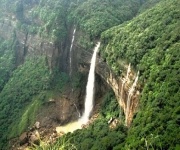
Many living root bridges are reached by forest trails with steep steps, uneven ground, and long sections exposed to rain. The journey may involve stream crossings and humid conditions, especially during the monsoon. Reaching a bridge is part of the experience because the route reveals the dense vegetation, waterfalls, and valleys that make Sohra distinctive.
The famous double-decker living root bridge at Nongriat is a popular example, although other root bridges are scattered across Meghalaya. Trail conditions change with weather, and walking times vary according to fitness, stops, and seasonal water levels. A local guide can provide practical direction, explain community customs, and help visitors avoid unsafe sections.
Before arranging an itinerary, travelers can review the site’s travel resources for related information about attractions, accommodation, and planning around Cherrapunjee. It is useful to consider where to stay, how much time to reserve for trekking, and whether the route fits the group’s physical ability.
The contrast with a regular bridge is especially clear during the walk. A modern road bridge may take visitors close to a viewpoint with minimal effort, while a root bridge encourages slower travel through the landscape. Neither experience is automatically better; they provide different forms of access and different ways to understand Meghalaya.
Choosing The Right Bridge Experience
Travelers interested in architecture and engineering may enjoy seeing both kinds of structures during a Meghalaya trip. A regular bridge shows how roads, valleys, and waterways are connected through planned infrastructure. A living bridge demonstrates how communities can create useful passageways by working with the growth patterns of trees.
For families, older travelers, or visitors with limited mobility, accessibility should be assessed before selecting a root bridge trek. The trails can be demanding and may lack the smooth surfaces, handrails, and predictable gradients associated with modern infrastructure. A viewpoint or easier forest walk can provide a safer alternative while still offering an understanding of the local environment.
A multi-day itinerary makes it easier to combine waterfalls, caves, viewpoints, villages, and root bridges without rushing. Travelers who prefer a structured visit can examine the 3N/4D Cherrapunji package, which offers a starting point for planning a short stay around the region’s major sights.
The best comparison is therefore experiential as well as technical. A regular bridge is efficient, predictable, and adaptable to high traffic. A living root bridge is patient, place-specific, and inseparable from the forest that sustains it. Visiting both helps explain why Meghalaya’s built heritage cannot be understood through modern construction standards alone.
Planning A Responsible Visit
A little preparation protects travelers and the bridges they come to see. Weather in Cherrapunjee can change quickly, and trails may become slippery after rain. Comfortable footwear, drinking water, light food, sun and rain protection, and a small first-aid kit are useful for longer walks.
Keep these points in mind when planning a root bridge excursion:
- Wear shoes with reliable grip for wet steps, mud, and uneven rock.
- Carry reusable water bottles and take all packaging back from the trail.
- Follow local guidance, stay on established paths, and avoid climbing or jumping on fragile sections.
- Allow extra time for rain, photography, rest stops, and changing stream conditions.
- Arrange transport and accommodation in advance during busy travel periods.
Respect for local customs is as important as physical preparation. Ask before photographing people, avoid loud behavior near homes or sacred places, and support local guides and small businesses where possible. These choices help ensure that tourism contributes to the communities that have maintained the bridges for generations.
The living root bridges of Cherrapunjee offer a lesson that conventional infrastructure rarely provides: durability can emerge through patience, cooperation, and care for a living environment. Regular bridges remain indispensable for modern mobility, yet root bridges show that effective design does not always begin with manufactured materials.
Plan a stay in Sohra that balances comfortable transport with time on the forest trails. Explore the waterfalls, caves, villages, and living bridges at a respectful pace, and let the journey reveal how Meghalaya’s people have built connections across the landscape without separating themselves from it.