




The best non-touristy waterfall you can reach by car
Most visitors to Meghalaya arrive with a familiar wish list: Nohkalikai Falls, the Seven Sisters, a cave, a living root bridge and somewhere to watch the rain arrive. The waterfall that best fits a quieter, non-touristy escape with car access is Nohsngithiang, near Pynursla in the East Khasi Hills. This tall, three-tiered cascade delivers the drama without the relentless traffic of the busiest Sohra stops or the commitment of a multi-day trek.
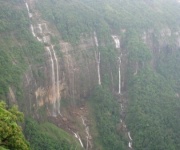
Nohsngithiang is not an undiscovered secret, and it can become busy when day-trippers arrive together. The advantage is relative: compared with the main Cherrapunji sightseeing circuit, you get more space, a greener approach and the feeling that the stop belongs to people who came to see the waterfall rather than simply tick off Meghalaya’s best-known names. Sohra, better known to travellers as Cherrapunji, remains the base for attractions including caves, viewpoints and the celebrated Seven Sisters.
The trade-off is that “reach by car” means reaching the trailhead by car, not parking at the cascade itself. A short walking section finishes the journey, usually on wet, uneven ground during the monsoon. For Australian travellers, that is a manageable distinction: you can organise the transport, avoid a self-drive expedition and spend your energy on the walk rather than navigating unfamiliar rural roads. A private driver also makes an early departure or a weather change much easier.
Why Nohsngithiang offers a quieter escape
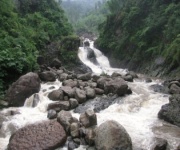
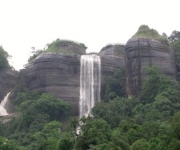
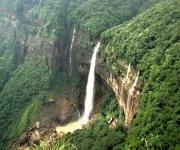
Nohsngithiang lies about 45 kilometres from Shillong, close to Pynursla in Meghalaya’s East Khasi Hills. Its stepped descent has three visible tiers, with the lower pools fed by a narrow upper fall. The viewing area brings the cascade into view through a lush setting of subtropical trees, bamboo and orchids. Flow changes dramatically with rainfall, so the same viewpoint can look powerful one day and modest the next.
That combination explains the appeal. Sohra’s familiar waterfalls are easy to include in a packed day, but Nohsngithiang asks for a little more distance and planning. Once you leave the main sightseeing road, the atmosphere becomes less urban and the photo points feel less crowded. At peak hours, though, you will still meet visitors and local guides; “quiet” describes the relative setting, not an empty guarantee.
It is a particularly good match for couples, families with older children and walkers who want a clear objective rather than a demanding expedition. It combines a memorable natural attraction with a half-day or full-day outing from Shillong. Add a local guide and the experience becomes informative as well as scenic, particularly when monsoon rain brings out the sounds, spray and colour of the forest.
Taking the car-trailhead route to the falls
Start in Shillong and head towards Pynursla, then follow the signed local access toward Nohsngithiang. A hired car with a local driver is usually the easiest option. Australians drive on the left as they do in India, but road markings, overtaking habits, livestock, motorcycles and monsoon potholes create a very different rhythm from home. A driver who knows the route can also judge whether the access road is safe that morning. Your vehicle may need to turn around while you continue on foot.
The final approach is a walking section, and its condition changes with the season. Steps, sloping rock and muddy ground are possible, and heavy rain can make the descent slippery. Wear shoes with good grip, carry water and keep a small portion of your day flexible for the walk. Do not attempt to drive the last stretch if it is flooded, soft or restricted; the convenience of a car does not override local access instructions.
Ask the driver to wait, agree on the exact meeting point and carry an offline map because mobile reception can fade between villages. Keep your phone charged, but do not depend on a signal for the whole return trip. An early start offers softer light and fewer people. When the forecast shows storms, allow enough time to return before a late-afternoon downpour. A local guide can also help with the approach and explain how water flow changes through the hills.
What the short walk actually feels like
At the viewpoint, the waterfall is experienced as a series of drops rather than one sheer plunge. Water threads down through the vegetation, gathers into a lower pool and continues below the viewing area. The upper tiers are easier to appreciate after substantial rain, while a lower flow reveals the rock and forest structure. Listen as well as look: the falling water carries clearly through the quiet, and the surrounding vegetation makes a strong case for keeping to the established paths.
This is a place to enjoy from the designated platform, not to scramble over for a closer photograph. Rock beside a waterfall can be unstable when wet, and runoff may rise quickly during intense rain. Swimming is not part of the visit. Binoculars are more useful than a heavy camera bag, and a waterproof sleeve is sensible for phones. A light layer also matters: shaded forest and spray can feel cool even on a warm Meghalaya day.
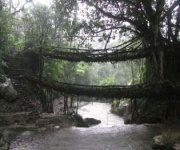
For broader itineraries, pair Nohsngithiang with time in Sohra rather than rushing every stop into one circuit. Riwai’s living root bridge and the caves around Cherrapunji deserve unhurried visits, while Shillong provides a practical base before and after the day. A three- or four-night package can leave room for a resort or hotel stay, weather days and a second, less familiar waterfall. That space is what turns a collection of sightings into a genuine Meghalaya journey.
Practical recommendations for visiting from Australia
Australian travellers will usually begin in Sydney, Melbourne or Brisbane and connect through an Indian or Southeast Asian hub before continuing to Guwahati or another gateway. Long transit times make a two-night minimum sensible, but the reward is access to landscapes entirely different from a domestic weekend. Confirm your Indian visa eligibility on official government channels, carry your passport and visa, and obtain an International Driving Permit from your Australian state or territory licence authority if you intend to drive. The permit accompanies your home licence; it does not replace it.
Budget in Indian rupees rather than assuming Australian card rules will apply. Cards may work at larger hotels, established restaurants and some tour offices, but smaller stalls, local transport and fuel stops are more likely to need cash. UPI is part of everyday Indian life, yet international cards and foreign payment apps do not always work as visitors expect. Carry a modest amount of small-denomination rupees, keep a second payment method, and avoid exchanging money through unofficial street dealers. Prices at formal markets are usually fixed, while gentle haggling may be acceptable at tourist stalls.
Australians are not generally expected to leave routine tips in the way some other travellers are led to believe, so tip only when a service warrants it. On timing, remember that Australian summer school holidays in December and January overlap Meghalaya’s cooler, rain-bearing season, whereas the main southwest monsoon usually builds from around May into September. For another Asian family journey, a Hong Kong trip timing guide offers a useful parallel: compare local seasons, crowds and wet-weather options instead of copying the Australian calendar.
These practical choices will make the waterfall day easier to manage:
- Book a private car with a Shillong-based driver, agree on the return meeting point and allow waiting time rather than assuming an instant pickup.
- Treat the final approach as a walking trail, using grippy shoes and a waterproof bag for phones, documents and other essentials.
- Carry a modest supply of Indian rupees and a backup card, and download offline maps because reception can disappear along the local access road.
- Build in a weather alternative, including a cave visit or a relaxed stay, so heavy monsoon rain does not compress every activity into one day.
- Check visa, location-access and insurance conditions before departure, and choose a tour operator that clearly explains its cancellation or rescheduling policy.
Make the quieter side of Meghalaya yours
A good booking should connect the waterfall to the rest of your Meghalaya stay, not sell you a rushed transfer with no contingency. Ask the operator to confirm the exact viewpoint access, expected walking time, vehicle waiting time and what happens if rain closes the road. Multi-day itineraries can also combine Sohra hotels or resorts with caves, root bridges and other waterfalls, giving you the option to move a day rather than lose one entirely.
For current two- to seven-night packages, attraction information and booking enquiries, explore Cherrapunjee trip details. The site is operated by India Beacons Sojourn, and its team can help shape a private waterfall day within a wider Meghalaya itinerary. Request an early Nohsngithiang departure, a local driver and a weather fallback, then leave enough space in the schedule to enjoy Sohra’s quieter side. A well-planned car-assisted visit keeps the spectacle while making the journey feel unhurried.