




The complete guide to the Nongriat village trails
Deep in the forested hills of southern Meghalaya, the trails around Nongriat offer one of India’s most memorable walking experiences. The route combines steep stone stairways, Khasi village paths, rainforest scenery, clear pools, and bridges shaped from the living roots of rubber fig trees. It is a journey that rewards patience and steady preparation rather than speed.
Nongriat is reached from Tyrna village, a short drive from Sohra, also known as Cherrapunji. Most visitors come to see the famous Double-Decker Living Root Bridge, but the surrounding trails lead to additional bridges, village homestays, streams, and Rainbow Falls. The landscape changes constantly as the path descends through thick vegetation and crosses narrow waterways.
Anyone planning a Meghalaya holiday can use the Cherrapunjee travel guide to understand local attractions, accommodation areas, seasonal conditions, and tour options. A visit to Nongriat fits particularly well into a longer Sohra itinerary, although the trek deserves a full day rather than a rushed stop between viewpoints.
Starting point and route
The walk begins at Tyrna, a compact Khasi village located at the head of the trail. Vehicles can usually reach the settlement by road, where trekkers begin descending a long flight of concrete and stone steps. The first section passes through houses, gardens, and cultivated slopes before entering denser forest.
The descent to Nongriat generally takes two to three hours, depending on fitness, weather, photography stops, and the condition of the path. Distances quoted by guides vary, but the number of steps is often estimated at more than 3,000 in total. The route is not technically difficult in the mountaineering sense, yet the continuous downhill walking places considerable strain on knees and ankles.
After reaching Nongriat, travelers can pause near the living root bridge and village homes before continuing toward Rainbow Falls. The extension follows narrower forest trails beside streams and over smaller crossings. Rainbow Falls is farther from the main village and requires additional walking, so visitors should begin early if they want to include it safely on the same day.
What the trek feels like
The trail has two very different physical demands. Going down may feel manageable at first, but the return climb is the real test. Humidity, wet steps, and repeated uphill sections can slow even experienced walkers. A relaxed pace with regular water breaks is more sensible than trying to complete the descent quickly.
Good footwear matters more than expensive equipment. Choose shoes or sandals with firm grip, secure straps, and enough protection for uneven steps. Flip-flops are unsuitable for the forest section, especially after rain. Walking poles can help on slippery slopes and reduce pressure on the knees during the long ascent.
| Trail section | Approximate walking time | Main conditions | Planning note |
|---|---|---|---|
| Tyrna to Nongriat | 2–3 hours downhill | Many steps, forest paths, humid air | Start early and carry drinking water |
| Nongriat to Rainbow Falls | 1–2 hours each way | Narrow trails, streams, uneven ground | Allow extra daylight and avoid rushing |
| Nongriat to Tyrna | 3–4 hours uphill | Continuous ascent and tired legs | Keep energy snacks for the return |
| Tyrna to Sohra by vehicle | About 45–75 minutes | Hill roads and changing traffic | Arrange transport in advance |
Travelers who rarely hike should treat the route as a demanding day walk. Mild muscle soreness is common, but sharp pain, dizziness, or exhaustion should be taken seriously. The trail is more enjoyable when the schedule allows time to stop at viewpoints, talk with residents, and appreciate the forest instead of focusing only on reaching the bridge.
Living root bridges and forest landmarks
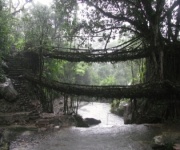
The Double-Decker Living Root Bridge is the signature sight in Nongriat. It was developed by guiding the aerial roots of Ficus elastica trees across a stream and allowing them to strengthen over many years. The result is a natural footbridge that remains connected to the living trees around it. Its layered design gives the structure its distinctive name.
These bridges are examples of Khasi ecological knowledge and long-term landscape management. They are not built in a single season. Roots are trained, supported, and maintained across generations, which explains why some bridges can remain useful for decades or even centuries. Their strength increases as the root system grows, although visitors should still follow local instructions about access and weight.
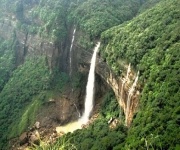
The pools near the bridge are inviting on warm days, and some travelers choose to swim where conditions are considered safe. Water levels and currents can change quickly after heavy rain, so local guidance should take priority over photographs or online assumptions. Rainbow Falls is another highlight, with water dropping through a lush gorge into a pool surrounded by steep forested walls.
The route itself is part of the attraction. Ferns, moss, orchids, bamboo, broad-leaved trees, and small streams create a cool green corridor below the open hills of Sohra. Bird calls and insects are often easier to notice during quieter stretches, particularly in the morning before larger groups arrive.
Choosing the right season
The trail can be visited throughout much of the year, but each season produces a different experience. From October to April, conditions are generally more comfortable for walking, with clearer paths and a lower chance of prolonged rain. November through February may feel cooler, especially in the early morning, while daylight hours are shorter.
The monsoon brings the dramatic scenery for which Meghalaya is known. Waterfalls become fuller, streams move faster, and the forest takes on an intense green color. At the same time, steps can become slick, visibility may change rapidly, and heavy rainfall can make smaller crossings unsafe. Visitors traveling between June and September should monitor local conditions and accept that plans may need to change.
The best daily timing is usually an early start from Sohra or Tyrna. Morning departures provide more daylight for the return journey and reduce the risk of walking the forest section after dusk. They also leave room for delays caused by rain, crowded steps, photo stops, or a longer break at Nongriat.
Planning transport and overnight stays
Nongriat is commonly visited as a day trip from Sohra, where many hotels, resorts, guesthouses, and homestays are available. A private vehicle or pre-arranged taxi is useful because the trailhead lies outside the main sightseeing cluster. Public transport options may be limited or less convenient for travelers trying to coordinate an early departure and a fixed return.
Some visitors choose to stay overnight in Nongriat or nearby villages. A simple homestay can make the experience less rushed and allows time for Rainbow Falls, nearby bridges, and quiet morning walks. Facilities are basic compared with hotels in Sohra, so travelers should expect limited connectivity, simple meals, and modest rooms. Booking ahead is wise during weekends and peak holiday periods.
A two-night Sohra itinerary can provide a practical base for the trek, with time for other local attractions such as waterfalls, caves, viewpoints, and village areas. The Sohra two-night package may suit visitors who want transport, accommodation, and sightseeing arranged together rather than organizing each part independently.
Carry enough cash for local purchases, guides, homestays, snacks, and transport. Mobile connectivity may be inconsistent in the valley, and card payments cannot be assumed at small village businesses. Travelers should also keep identification and any required travel documents accessible. Indian and international visitors should check current Meghalaya entry, registration, and permit guidance before departure because administrative requirements can change.
What to carry and how to walk responsibly
Pack lightly, since every extra item becomes harder to manage on the return climb. A small backpack is preferable to a suitcase, and a waterproof cover helps protect phones, cameras, medication, and spare clothing. Even during dry months, a light rain jacket is useful in a region known for sudden showers.
Food and water are available in limited places, but supplies should not be taken for granted. Carry a reusable bottle, oral rehydration salts, fruit, nuts, or energy bars. Insect repellent, sunscreen, a basic first-aid kit, personal medication, and a small towel are also practical additions. A dry shirt for the return journey can make the final climb much more comfortable.
Respect for the village and the forest is essential. The bridge is a community heritage site, not an amusement structure, and visitors should avoid jumping, pushing, climbing on tree trunks, or leaving marks. Keep voices low near homes, ask before photographing residents, and dress in a way that is comfortable and considerate in a rural Khasi community.
Use these habits to make the walk safer and more sustainable:
- Begin early enough to finish the forest sections in daylight.
- Wear footwear with dependable grip and carry a rain layer.
- Bring reusable water containers and take all packaging back out.
- Follow local advice about swimming, stream crossings, and closed paths.
- Hire a local guide when route conditions are unclear or when exploring beyond Nongriat.
A guide can explain the history of the living root bridges, identify plants and birds, and help visitors interpret local customs. Local spending also supports the people who maintain paths, provide meals, operate homestays, and preserve the living bridge tradition.
Building the trail into a Meghalaya itinerary
The Nongriat walk works best when placed alongside, rather than squeezed between, major sightseeing stops. Sohra has enough surrounding attractions to fill several days, including dramatic waterfalls, limestone caves, forest reserves, cliff viewpoints, and small settlements. Keeping the trek as the main activity on one day avoids the fatigue of combining it with a long list of distant locations.
A sensible schedule may include arrival and nearby viewpoints on the first day, the Nongriat trek on the second, and caves or waterfalls on the following day. Travelers with more time can add Mawlynnong, Dawki, Shillong, or other parts of Meghalaya, though road journeys can take longer than map distances suggest because of winding hill routes and changing traffic.
The route is suitable for many active travelers, but it is not ideal for anyone with serious knee, hip, heart, or balance problems unless a medical professional has confirmed that the exertion is appropriate. Children can complete the walk with attentive adults, while older travelers may prefer an overnight stay that breaks up the physical effort. There is no shortcut that removes the main stair climb, so honest assessment before departure is important.
Nongriat stays with visitors because its appeal goes beyond a single landmark. The living root bridges show how a community has worked with the forest over generations, while the trail reveals a quieter side of Meghalaya that cannot be experienced from a vehicle. With suitable shoes, an early start, flexible plans, and respect for local life, the journey becomes one of the defining experiences of a Cherrapunji vacation.
Plan your route around daylight and weather, reserve transport or accommodation early, and allow enough time to walk without rushing. For bookings and a broader Sohra travel plan, contact India Beacons Sojourn through Cherrapunjee.net and make the Nongriat trails a carefully prepared part of your Meghalaya journey.