




Khasi Heritage and the Living Landscape of Cherrapunjee
In the folds of Meghalaya's southern plateau, a culture older than most nation-states still shapes daily life. The Khasi people have called these misty ridgelines home for thousands of years, building a society that turns rainfall into a partner rather than an adversary. For Australian travellers familiar with Cairns tropical downpours or Blue Mountains mist, Cherrapunjee offers a familiar climate with a twist: clouds arrive almost every afternoon, the soil drinks deeply, and locals flourish within the pattern.
The link between the highland community and the plateau runs deeper than its famous waterfalls. Sohra, as locals still call the town, has long served as a cultural and political heart for the wider Khasi-Jaintia people. To walk through its limestone hamlets today is to read layered history in stone steps, stilted houses, and bamboo ladders climbing toward village councils. Each ridge carries memory.
The Ancient Origins of the Khasi People
Linguistic studies place the Khasi among the Austroasiatic language family, a grouping that links them to communities across mainland Southeast Asia rather than to Indo-European populations of the Indian plains. Oral traditions describe seven main clans, the Ki Hynniewtrep, said to have descended from the first seven heavenly huts. Scholars debate whether these stories preserve a memory of Mekong basin migration or describe ancient local settlement, but the underlying claim is consistent: the highland clans consider themselves among the oldest continuous inhabitants of this plateau.
Archaeological finds in and around Cherrapunjee reinforce that antiquity. Neolithic tools, stone axe heads, and burial urns have surfaced from the limestone terraces over the past century, suggesting organised communities lived here long before the Ahom or Koch kingdoms rose to the north. The plateau's natural caves served as both shelters and ritual chambers, and many still bear soot marks from ancient fires alongside carved motifs whose meanings remain only partly understood.
The Khasi world view centres on a belief that land belongs to the community rather than to individuals. This principle, known as Ri Kynti, governs everything from forest use to house construction, and it predates modern conservation frameworks by many centuries. For Australian visitors familiar with Aboriginal land councils and native title discussions, this parallel offers a useful lens: both cultures treat the earth as a relative rather than a resource.
Sohra as the Historical Khasi Seat
During the early nineteenth century, Cherrapunjee served as the British administrative headquarters for the Khasi and Jaintia Hills, a role that brought surveyors, missionaries, and botanists into the region. Lieutenant Yule and later administrators mapped the plateau, recorded its rainfall statistics, and helped turn it into a byword for the wettest place on earth. Yet long before umbrellas and barographs arrived, Sohra was already a market town and ceremonial gathering point.
The Syiem of Sohra, a traditional chief whose authority stretched across surrounding villages, managed justice, taxes, and dispute resolution in ways the colonial administration eventually had to recognise. British records from the 1830s describe a working council where village elders debated matters under ficus trees. Some of those trees, descendants of the originals, still stand in parts of the plateau, and their root systems have been coaxed into bridges, platforms, and viewing decks by successive generations.
Markers of Sohra's long Khasi legacy
- The Sohra market square, where livestock and handicrafts have traded for over three centuries
- The ruins of the old British residency, perched above the plains
- Standing stone markers once used by village elders to settle boundary disputes
- The Syiem's traditional residence, still used for council gatherings during festivals
- Sacred groves surrounding the town, preserved under Ri Kynti land rules
- The limestone cave network beneath the plateau, partly mapped during the 1840s
These sites remain accessible to curious visitors, and most sit within walking distance of the town centre.
Language, Music, and Oral Storytelling
Khasi, or Ka Ktien Khasi, is spoken by roughly 1.4 million people across Meghalaya and parts of Assam and Bangladesh. It uses the Latin script introduced by Welsh missionary Thomas Jones in the 1840s and has a rich tradition of folk songs marking everything from rice planting to wedding negotiations. The poetic form known as ki phawer uses metaphor and short verses to pass on moral instruction, and young people often learn these by heart before they ever pick up a textbook.
Instrumentation is gentle and organic. The duitara, a four-stringed instrument resembling a small lute, accompanies most storytelling evenings, while bamboo flutes add a breathy counterpoint during harvest celebrations. A traveller spending an arvo in a village homestay might be invited to listen as a grandmother recites the tale of Sohra's seven rivers, each one a sister who left the plateau in a different direction. These narratives encode real geography, real flood patterns, and real kinship history.
Music also binds communities during the Shad Suk Mynsiem, a thanksgiving festival held in early April. Dancers wear silver crowns, silk shawls, and ancestral turbans, moving in slow circular patterns that honour both creator and ancestors. The festival has a public, performative layer and a private, devotional one, and only a careful observer sees both.
Living Root Bridges and Bio-Engineering
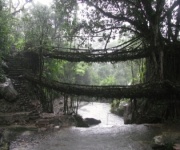
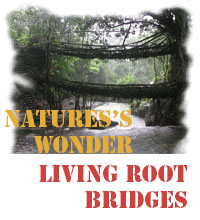
Perhaps the most photographed element of local heritage is the living root bridge, a bio-engineered structure grown from the aerial roots of the Ficus elastica tree. Over decades, the Khasi have trained these roots across streams, anchoring them on the far bank until they thicken into a usable crossing. Some of the most famous examples near Cherrapunjee, including the double-decker structure at Nongriat, are well over a century old and still carry foot traffic daily.
These bridges are not folk curiosities. They represent a sophisticated understanding of plant physiology, hydrology, and long-term community planning. Construction is rarely the work of a single lifetime; a great-grandchild may be the one who walks the finished span. This patient, multi-generational thinking aligns closely with the Aboriginal Australian concept of caring for country, where decisions are weighed across several generations rather than one electoral cycle.
The practice also illustrates how the highland community works with rainfall rather than against it. Heavy monsoon flow would destroy any conventional wooden bridge within a decade, but a living root structure flexes, grows, and self-repairs. Visitors who have bushwalked the Daintree or scrambled Tasmania's mountain creeks will appreciate the engineering logic, even if the scale here is unfamiliar. Several villages now host guided walks explaining the cultivation process, the maintenance rituals, and the community ownership rules that protect each bridge from overuse.
Sacred Groves and Forest Spiritual Practice
Local religious life blends Presbyterian Christianity with older beliefs centred on nature spirits, ancestral guardians, and sacred groves. Most highland villages maintain at least one law kyntang, a protected forest patch where cutting is forbidden and where offerings of rice, eggs, or fermented millet are made at specific times of year. The groves serve as biodiversity reservoirs, watershed protectors, and spiritual anchors, and they are sometimes the only places in the surrounding landscape where old-growth trees still stand.
Animist practitioners, sometimes called Niam Khasi or Seng Khasi, hold ceremonies that align with agricultural and celestial cycles. The spring ritual of Shad Shnong asks for the cleansing of the village before sowing season, while autumn observances give thanks for the harvest and remember the recently deceased. Christian Khasi families frequently participate in both, treating them as complementary rather than competing systems. For Australians used to the layered spirituality of urban multicultural communities, this coexistence feels familiar.
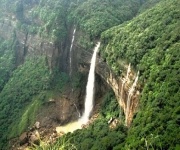
Sacred sites also dot the plateau, including limestone caves believed to house spirits who control rain. Mawsmai and Krem Mawmluh are the most accessible to visitors, and a guided caves safety tour for beginners is the easiest way to explore them responsibly. Local guides explain which formations are venerated, where offerings have been left, and how caves have served as refuge and ritual space since the Neolithic period. The atmosphere inside, where waterfalls echo and light filters through fern-fronded openings, often invites the quiet reflection usually associated with ancient stone country.
Seasonal rituals that connect Khasi communities to the land
- Ka Pomblang, the November thanksgiving marking the year's end
- Shad Shnong, the spring cleansing before sowing season
- Shad Suk Mynsiem, the April dance festival honouring the creator
- Beh dieng khasi, ritual offerings made at the sacred forests
- Ka Bam Khasi, ceremonies held at ancestral stone sites
- Hearth prayers offered by families during monsoon breaks
Each ritual reinforces the bond between household, village, and the wider natural world.
Khasi Identity in a Connected World
Contemporary Khasi society faces pressures familiar to many indigenous communities worldwide: youth migration to Shillong and beyond, language dilution, and economic shifts away from subsistence farming. Yet the cultural infrastructure remains strong, with Khasi-language media, literature, and online communities flourishing alongside traditional village councils. Cherrapunjee in particular has become a focal point for heritage tourism, and the income generated helps fund school programs, language nests, and the maintenance of community forests.
Australian travellers planning a Meghalaya itinerary often find that Cherrapunjee pairs well with Dawki's crystal river, Mawlynnong's tidy lanes, and Shillong's music scene. A two-night stop covers the headline waterfalls and a single village visit, but those with a fortnight can walk the longer root bridge trails, attend a seasonal festival, and spend unhurried mornings with Khasi families who host homestay guests. Many visitors from Sydney and Melbourne arrange their trip during the cooler dry months between November and February, when clouds lift often enough to reveal the Bangladesh plains on the horizon.
The local story is ultimately one of continuity through change. The same plateau that once sheltered Neolithic hunters now welcomes guests with brewed black tea and warm hospitality. The same rivers that fed the first root bridges still nourish the villages that maintain them. The same language that carried Ki Hynniewtrep prayers a thousand years ago still tumbles out in market stalls, kitchen conversations, and folk songs at the village square. For anyone curious about how a culture can stay rooted while reaching outward, Cherrapunjee offers a vivid and welcoming classroom.
For travellers inspired by these layers of history, the practical next step is a journey built around them. A well-paced seven-night Cherrapunjee package weaves together caves, living bridges, and village stays, while independent explorers can reach out directly to India Beacons Sojourn through the contact details on the website to design a trip around the seasons, festivals, and trails that match their interests. Cherrapunjee is ready when you are, and the highland community has been welcoming thoughtful travellers for generations.