




The most peaceful spots for meditation in Cherrapunjee
Cherrapunjee sits among the wettest uplands on Earth, a Khasi Hills town where rain falls for months on end and the limestone drips with life. For travellers arriving from Sydney or Melbourne, often after a Qantas or Singapore Airlines hop through Singapore, the place feels like stepping into another century. Australians used to the ochre quiet of the Red Centre or the eucalyptus hush of the Blue Mountains recognise a kindred stillness here, but with a green density that has no counterpart in the outback. The cliffs, the caves, and the living root bridges all conspire to slow the breath almost involuntarily.
What draws many Aussie visitors is the rainfall, and the rhythm it imposes. Mornings begin with mist lifting off the banana groves, afternoons arrive in silver curtains, and evenings settle into a soft, almost monastic hush. Meditation, in this context, does not have to be scheduled or led by a guru with a bell. A pause on a wet stone, a few mindful breaths beneath a living bridge, or twenty minutes of staring at a waterfall can become a practice in itself. The places below are chosen because they hold that quality of stillness without effort, and they pair well with the sort of reflective travel that suits Australians on a long-haul break from work.
Living root bridges as meditation spaces
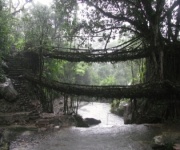
The living root bridges near Cherrapunjee are bio-engineered wonders, trained over generations by Khasi villagers to span rain-fed ravines. The most famous, the double-decker root bridge at Nongriat, asks for a steep descent of roughly 3,500 steps, which is half the practice in itself. Once at the base, the air cools and the only sounds are water on stone and the occasional call of a hill myna. Many travellers who live in busy cities like Brisbane or Perth find that the slow climb forces a kind of moving meditation, each step counted, each breath timed.
Closer to town and easier to reach is the Mawlynnong root bridge, often called the cleanest village in Asia. The path is gentler and the foot traffic higher, but a few steps off the main trail reveal quieter platforms where the rubber fig roots twist into natural armrests. Sitting there with eyes half-closed, you can feel the faint pulse of the tree above you, a sensation that Australians with a backyard fig tree in Adelaide or a Moreton Bay fig in a coastal park will recognise in some muted form. While in the region, consider exploring Cherrapunjee's local handloom weaving workshops as a complement, since the same patient, generations-long thinking shapes both the bridges and the looms.
Sacred caves for silent practice
Cherrapunjee's limestone is riddled with caves, and several of them have been used for centuries as places of retreat. Krem Mawmluh, whose entrance sits a short drive from Sohra town, is one of the longest in the Indian subcontinent. Its interior stays at a steady cool temperature year-round, a welcome contrast for visitors used to the dry heat of an Australian summer. Inside, the formations are subtle rather than spectacular, which suits contemplation; the mind does not get pulled into wonder so much as invited into quiet.
Arwah Cave is closer to the main road and has easier footing, though it is no less atmospheric. A short walk into its mouth, where the daylight thins to a grey-green glow, is enough to feel the hush of deep stone. Australians on a wellness trip, the sort who might normally book a silent retreat at a place like Billabong Retreat in the Hunter Valley, recognise the appeal of a cave that simply asks for stillness. There are no guided sessions here, no props, no chanting required; the cave provides the frame, the traveller provides the attention.
| Meditation spot | Accessibility | Best time | Sound environment |
|---|---|---|---|
| Nongriat root bridge | 3,500 steps down and back | Early morning, dry months | Water on stone, faint bird calls |
| Mawlynnong root bridge | Gentle steps, village trail | Mid-morning | Distant village life, soft water |
| Krem Mawmluh cave | Short drive, guided walk | Midday | Absolute quiet, occasional drip |
| Arwah Cave | Short walk from road | Late afternoon | Near silence, faint air movement |
| Nohkalikai viewpoint | Easy walk from car park | Sunrise or late afternoon | Roaring falls, wind in ferns |
Waterfall edges for mindful listening
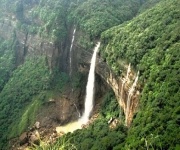
Few places in the world combine the vertical drop and the volume of Cherrapunjee's waterfalls. Nohkalikai, which plunges from around 340 metres, is the tallest in India and one of the highest plunge falls on the planet. The viewpoint is a flat concrete platform with a railing, and the spray drifts across it in shifting veils. Sitting on the low stone wall at the rim, eyes open or closed, the roar becomes a kind of white noise that dissolves intrusive thought the way a didgeridoo drone settles a restless mind. Many travellers from Australia find this sound oddly familiar; it has the same enveloping quality as a heavy surf at Bondi or Bells Beach.
Wei Sawdong, by contrast, is a series of three cascades reached by a longer trek through shaded forest. There is almost no infrastructure at the viewing point, which is precisely the point. Visitors who come here are usually alone, and the practice is less about visual focus than about the rhythm of breath matching the rhythm of falling water. The Seven Sisters Falls nearby offer a different frequency, lower and more sustained, and they are often visited in late afternoon when the light turns copper. Australians who have trekked in Tasmania's Cradle Mountain or the Larapinta Trail will appreciate the simple act of stopping and listening that these spots demand.
Mist-laced hilltops for sunrise practice
Cherrapunjee sits at an altitude where sunrise is rarely the bright, instant affair of the tropics. Instead, the light arrives in layers, first as a paling of the eastern sky, then as a slow reveal of ridges through shifting cloud. The Thangkarang viewpoint, a short drive from town, is one of the most reliable places to watch this unfold. Local guides will arrange a pre-dawn pick-up for around 4:30 am during the dry months, and thermos flasks of lemon-ginger tea are part of the ritual. Sitting on a low stone bench, wrapped in a light shawl, is a softer start to a sitting practice than a sharp alarm in a Sydney apartment.
Laitkynsew offers a similar experience with a touch more elevation. The walking path is a slow twenty-minute climb through open grassland, and at the top the views sweep across the Bangladesh borderlands on a clear day. Australians who have driven the Great Ocean Road at dawn will know the feeling of a horizon that refuses to behave like a line, and Laitkynsew's haze plays the same gentle trick. Bring a small cushion; the ground is damp most mornings even in the dry season.
Quiet corners near Sohra town
Not every meditation spot requires a trek. Within a few kilometres of Sohra town centre there are tucked-away corners that locals have used for decades as places of pause. The grounds around the Don Bosco Museum, set on a rise above the valley, include a long, shaded verandah that looks out toward the falls. It is rarely crowded outside school holidays, and the rhythm of monks moving between sessions gives the place a calm tempo without requiring visitors to join in. A simple donation and a respectful silence are the only expectations.
Closer still, the gardens behind several of the older resorts hold benches positioned toward the valley. These are not advertised as meditation spots, but they function as such, and they suit travellers who want to weave short sits into a longer touring day rather than commit to a single remote location. For Australians used to the open-ended nature of a Cairns hinterland retreat or a Margaret River forest stay, this loose, off-the-cuff approach to silence often feels more natural than a formal programme.
Preparing for stillness in the hills
- Carry a thin, quick-dry mat; the grass and stone are damp even after a dry morning.
- Pack a light shawl or fleece; the temperature drops noticeably before sunrise, similar to a Ballarat winter morning.
- Plan sits for the first half of the day when the mist is still soft; afternoons often bring cloud build-up that closes the views.
- Choose footwear with grip on wet limestone; a hiking sandal with a heel strap works better than smooth trainers.
- Book at least two nights locally to avoid a rushed day trip from Guwahati, which adds four hours of road each way and eats the calm you came for.
- Carry small AUD-denominated travel notes on quiet hours you might want at sites like Nohkalikai or the Thangkarang viewpoint, since peak chatter can disrupt a sitting.
Cherrapunjee rewards the patient traveller with a kind of quiet that is hard to find in busier Indian circuits. If you are planning a short escape from Australia and want the meditation woven into the journey rather than bolted on, consider the two-night Cherrapunjee tour as a starting point. It balances the major viewpoints with time to simply sit, and it leaves room to return to one particular spot on your own. A quick email to the local team is often enough to tailor the route around a few extra hours of stillness, since Australians tend to ask for the quieter corners once they have seen the headline sights.