




Secret Swimming Holes Around Cherrapunjee Every Aussie Should Know
Few places on earth claim the kind of rainfall that Cherrapunjee does, more than ten metres a year, falling in sheets that have sculpted the sandstone into slides, bowls and hidden basins. For travellers boarding a long-haul flight from Sydney or Brisbane, the promise of swimming through rainforest gorges and bathing beneath thundering cascades feels tantalisingly far from the daily grind of office lifts in Melbourne's CBD. The good news is that the journey is well within reach, and the payoff is a string of pristine bathing spots the rest of the world rarely hears about.
These are not the crowded swimming complexes Australians might imagine when they picture a tropical holiday. Instead, you will find yourself slipping into cool, jade-green pools shaded by tree ferns, where kingfishers flick above the water and the only sound is a distant waterfall carving its way through the cliffs. Most visitors combine a few of these natural swimming stops with the famous living root bridges, a side trip to Mawsynram or even a cave exploration, and that combination is exactly what the curated Cherrapunjee tour packages are designed around.
The Geology Behind Meghalaya's Hidden Pools
Cherrapunjee sits on the edge of the Meghalaya subtropical forests, a UNESCO biosphere reserve where the annual monsoon has been working on limestone and sandstone for millions of years. Each downpour eats a little more at the softer rock, hollowing out plunge pools, scooping natural slides and leaving behind a chain of crystal-clear basins along every stream. Because the water drains through forest floor rather than open farmland, these pools stay remarkably clean, a quality even the pickiest swimmers from Bondi to Cottesloe would appreciate.
The region's rivers and streams pulse with water from October through May, then again briefly after the first pre-monsoon showers in April. That timing lines up neatly with Australian winter holidays and shoulder breaks, when teachers, nurses and tradies in Perth and Adelaide start looking at cheap flights to Guwahati. Hitting the pools in the right window is the difference between a gentle float and a roaring torrent, which is why most itineraries build in a buffer day.
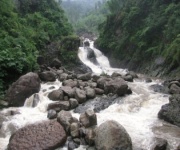
The deeper you go into the boulder fields, the more improbable the bathing spots become. Some sit in natural rock tanks barely larger than a plunge pool at a resort, while others stretch across sheltered bends where the river loses speed and turns a glassy emerald.
Plunging Below Nohkalikai Falls
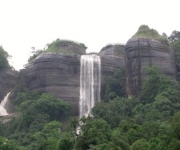
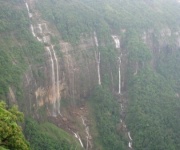
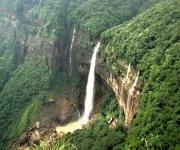
The most photographed waterfall in the country, Nohkalikai drops roughly 340 metres off a forested cliff into a turquoise basin you can actually reach on foot. A short, somewhat slippery walk leads to the base, where the spray catches sunlight and the pool opens up between mossy boulders. Swimming here is permitted in calmer months, and locals will tell you exactly when the currents are safe to enter.
A swim beneath Nohkalikai is not about covering laps — it is about the strange thrill of looking straight up at falling water from below. Bring waterproof phone housing if you want to capture it (the moisture alone can drench a camera in seconds), and time your visit for late morning when the light slants across the pool. Travellers from Australia often pack their quick-dry travel towels and reef-safe sunscreen, the same kit they would take to a Melbourne beach in February, but here it earns its keep among the ferns.
The mist from the falls drifts over the pool for hours after each downpour, so even a mid-afternoon visit can feel like a private spa. Guides often suggest a few minutes of stillness in the shallows before wading deeper, an easy habit to pick up on a mountain holiday.
Mawlynnong's Crystal-Clear Bathing Spots
Mawlynnong, billed as Asia's cleanest village, sits less than two hours from Cherrapunjee and offers some of the gentlest swimming on the plateau. Bamboo dustbins line the lanes, flowers spill from balconies, and just past the village boundary a small stream opens into a deep, glassy pool. The water is cold enough to wake you up after a long drive from Dawki, but it warms beautifully by midday when the sun catches the surface.
Most visitors pair the swim with a walk through the village itself, stopping for khapse biscuits and steaming cups of local tea. A handful of Khasi families offer simple guesthouses, and the easy access makes this an ideal first swim for families travelling with younger kids who might find longer treks overwhelming. Soft drinks and packaged snacks are limited, so pick up treats like Tim Tams in Guwahati before the climb if you want a taste of home waiting in your daypack.
A short climb above the pool reveals a series of small bathing basins used by locals in summer, each one tucked into a hollow of rock and shaded by wild fig trees. These are the spots most Australian visitors never hear about until they meet a guide who grew up swimming in them.
The Living Root Bridge Swimming Circuit
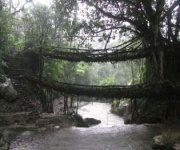
The combination trek — walking between several living root bridges, with swims at every stop — is probably the highlight of any week-long itinerary. Days begin early, the air smells of damp earth and eucalyptus-scented khasi pine, and by mid-morning you are stripping off to slip into a forest pool framed by tangled roots. The bridges themselves are the main draw, but most trekkers agree the swims between them are the moments they remember longest.
Because these swims are scattered across a multi-day route, the Cherrapunji 6N-7D package tends to be the most popular format for visitors coming in from the southern hemisphere. It bundles transfers from Guwahati, accommodation, guides and the right permits into a single booking. The route also leaves room for spontaneous dips at unmarked pools only locals frequent, which guides will point out if you ask.
The lowest bridge along the circuit usually marks the halfway point, where a generous rock shelf forms a natural sundeck in the late afternoon. Pack a microfibre towel and let your feet dry before slipping into walking sandals, since the red soil can be unforgiving on socks for the rest of the day.
Cave Pools and Underground Swimming
The same limestone that creates surface pools also runs deep underground, and several show caves around Cherrapunjee contain quiet, candle-lit bathing spots near the cave mouths. Mawsmai is the most visited and easiest to explore, with a few natural basins that fill after heavy rain. Krem Mawmluh, longer and more adventurous, has chambers where you can wade in waist-deep water wearing only a headlamp.
Cave swims are a different beast entirely from open-water ones. Temperatures stay constant, light disappears, and the acoustics turn a casual conversation into something cathedral-like. Most operators provide rubber shoes and a guide who knows which sections are safe for entry. Adventurous divers from Cairns or Coffs Harbour often find these spots familiar in spirit yet entirely distinct in geology, a reminder that Meghalaya's caves are millions of years older than anything back home.
After a long underground wade, the exit often opens onto a mossy cliff where a small cascade feeds a shaded pool. The contrast between the cool, still water inside and the rushing, sunlit pool outside makes the second swim feel like a reward.
Practical Tips for Travellers From Australia
A trip to Cherrapunjee from Australia usually runs through Singapore, Kuala Lumpur or Bangkok, with the final leg into Guwahati before a scenic drive up to Meghalaya. Indian e-visas are processed quickly online, and the local Indian rupee trades favourably against the Australian dollar in most seasons, so budget at least some cash for village stays and informal guides. Pack for proper rainforest conditions: quick-dry layers, sturdy grip shoes, a poncho, and the kind of dry bag you would take white-water rafting on the Franklin River.
Travel insurance that covers monsoon-season trekking is essential, and most Australian policies can be extended online before departure. Connectivity at the pools is patchy, so download offline maps and let someone know your route each morning. A small backup battery for your phone is wise, especially if you plan to photograph kingfishers along the way. If you find you have a quiet afternoon between treks, comparable slow-nature experiences like birding in Khao Sok make excellent reading while you wait out a rain band.
If the rain band lingers, expect to spend part of your trip dodging showers, and that is half the fun. Plan swims around the morning sun, reserve afternoons for tea stalls and village visits, and you will rarely be cold for long. Australia-based travellers used to packing patience for a Boxing Day Test will find the relaxed pacing here familiar and refreshing.
From the first clammy air outside Guwahati to the last rainforest shower before heading home, swimming in Cherrapunjee feels like discovering a secret the rest of the world has not caught on to yet. The pools are uncrowded, the locals welcoming, and the journey itself one you will recount for years. Australians weighing up their next big holiday should put this corner of India at the top of the shortlist and reach out to the team at India Beacons Sojourn to start planning the trip. It is the kind of adventure that makes a welcome change from the usual Bali repeat, and one that rewards every kilometre of the long flight east.