




The Story Behind the Double Decker Living Root Bridge
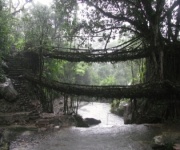
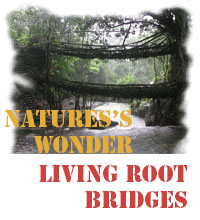
Deep in the green hills of Meghalaya, a bridge grows rather than being assembled. The Double Decker Living Root Bridge near Nongriat is one of the most remarkable examples of Khasi ingenuity, where carefully guided tree roots have become a strong crossing over the Umshiang River. Its tangled structure looks ancient and otherworldly, yet it reflects practical knowledge passed from one generation to the next.
The bridge is reached through a forested route from Tyrna village, near Sohra, also known as Cherrapunji. The journey includes a long descent of stone steps, several smaller crossings, and humid subtropical woodland filled with streams, ferns, moss, and thick vegetation. Reaching the bridge is therefore part of the experience: the landscape gradually reveals how closely local life is connected to the forest.
Unlike a conventional bridge, this living structure continues to develop. Its roots thicken, intertwine, and strengthen over time, allowing it to withstand heavy rain and powerful seasonal water flow. The story behind it is a story of patience, adaptation, community knowledge, and a distinctive relationship between people and trees.
A Bridge Shaped By Khasi Knowledge
The bridge is made from the aerial roots of the Indian rubber fig, Ficus elastica, a tree well suited to Meghalaya’s wet climate. These roots can grow outward from the trunk and remain flexible while they are young. Khasi communities learned to guide them across gaps and streams, gradually creating a natural framework capable of carrying people.
Traditionally, bamboo poles, betel nut trunks, or other temporary supports help direct the roots toward the opposite bank. As the roots reach the other side, they are encouraged to take hold in the soil. Over many years, new roots can be woven into the structure, filling gaps and making the crossing broader and more stable.
This technique is based on observation rather than a single construction event. Villagers understand how roots respond to moisture, sunlight, soil, and pressure. They also know where a crossing is needed and how to maintain it. The resulting bridge is an example of indigenous environmental engineering, created with living material instead of cut stone, steel, or concrete.
The term “double decker” describes the bridge’s two distinct levels. The lower and upper root walkways overlap around the river crossing, giving the structure its unusual vertical form. Local accounts differ about its age and development, but its strength clearly comes from long-term care rather than a fixed building date.
Why The Roots Matter
A living root bridge is not simply a natural curiosity. In the steep terrain around Sohra, villages are separated by deep ravines, fast-moving streams, and dense forest. During the monsoon, paths can become difficult or unsafe, while water levels rise quickly. A bridge that can endure wet conditions provides an important link between settlements, farms, and forest routes.
The rubber fig’s roots have qualities that make this possible. They are flexible enough to be trained into position and strong enough to form a load-bearing lattice once mature. When several roots overlap, they create a surface that can support foot traffic. Stones, soil, and plant growth may gradually settle into the gaps, adding weight and texture to the walkway.
The bridge also represents a different idea of maintenance. A concrete crossing is inspected for cracks and repaired with manufactured materials. A living bridge is observed as it grows. Roots may be redirected, strengthened, or replaced, and local knowledge remains essential to deciding what the structure needs.
Its ecological value is equally important. The bridge does not require clearing a wide road through the forest, and its basic material remains part of the surrounding ecosystem. The shaded route, flowing water, and mature trees create habitat for insects, mosses, ferns, and other plants. Visitors see a landmark, but local communities recognize a working part of the landscape.
The Journey To Nongriat
Most visitors begin the trek at Tyrna, a village located roughly 20 kilometres from Sohra by road, depending on the route and local conditions. From there, the path descends through forest and village areas toward Nongriat. The distance is manageable for prepared walkers, but the return climb makes the outing physically demanding.
The trail includes thousands of steps, uneven stone surfaces, narrow sections, and several smaller root bridges. Humidity can make the descent tiring, while rain may leave rocks and steps slippery. The forest changes as the path drops in elevation, with dense greenery and the sound of streams providing a constant backdrop.
A local guide can add much more than route-finding. Guides often explain how the bridges are maintained, identify plants, describe nearby villages, and help visitors move safely across wet or uneven sections. Their knowledge also encourages respectful travel in a place where the bridge remains part of community life rather than a decorative monument.
Many travelers spend time at the river and nearby pools before beginning the climb back to Tyrna. Starting early is generally sensible because it allows time for breaks and reduces the risk of returning after daylight fades. Weather conditions should be checked before setting out, particularly during intense monsoon periods.
| Feature | What It Means For Visitors |
|---|---|
| Location | Nongriat village area, reached from Tyrna near Sohra |
| Main material | Living aerial roots of the Indian rubber fig |
| Structure | Two overlapping root walkways forming the double-level crossing |
| Typical route | Forest trail, steep steps, smaller bridges, and stream crossings |
| Physical demand | Long descent followed by a strenuous uphill return |
| Best preparation | Grippy footwear, drinking water, light rain protection, and time |
| Cultural setting | A community-maintained crossing within a living landscape |
A Landmark That Keeps Growing
The most fascinating feature of the bridge is that its story does not end when visitors first see it. The structure is still alive. Roots can continue to thicken and merge, changing the shape and feel of the walkway. The bridge is therefore a record of many seasons, repairs, adjustments, and generations of use.
This slow growth explains why living root bridges cannot be reproduced quickly. Planting a tree and building a support frame does not create an instant replacement. The process depends on suitable trees, a stable location, patient guidance, and ongoing care. It also depends on the willingness of a community to preserve knowledge that may take decades to produce visible results.
The double level may have developed through successive root training and reinforcement rather than from a single original design. As a lower crossing matured, additional roots could be guided to create another passage above it. Local history and oral tradition remain important to understanding these changes, because the bridge’s development is recorded in community memory as much as in written documents.
That gradual process gives the bridge its character. The surface is uneven, the roots are visibly intertwined, and the structure feels organic underfoot. Each section shows a different stage of growth, making it easy to understand that this is both infrastructure and living woodland.
Respecting The Place
The route to Nongriat passes through villages and privately used land, so visitors should treat the area as a lived-in environment. Keeping noise low, following marked paths, and asking before photographing residents are simple ways to show respect. Local instructions about access, bathing areas, and photography should be followed.
The bridge itself can be damaged by careless behavior. Climbing on the side roots, forcing plants apart, carving names, or leaving litter weakens the structure and changes the experience for future visitors. Walking steadily along the established surface is safer for travelers and kinder to the living bridge.
Swimming in nearby pools may be possible in suitable conditions, but water levels and currents can change rapidly after rain. Visitors should avoid jumping into unfamiliar water and should follow guidance from local people. The same caution applies to the trail: wet stone steps can be hazardous even for experienced hikers.
Travelers planning a broader Meghalaya holiday can include the bridge within a five-night itinerary that also covers waterfalls, caves, viewpoints, and other attractions around Cherrapunji. Allowing a full day for the Nongriat trek helps preserve the experience instead of reducing it to a rushed stop between drives.
What To Carry And Expect
Comfortable footwear with a firm grip is one of the most important choices for this trek. Sandals may be convenient around a resort, but they offer less protection on muddy steps, wet rock, and uneven root surfaces. Lightweight clothing that dries quickly is useful in Meghalaya’s humid conditions.
A small backpack should include drinking water, snacks, basic personal medication, sun protection, and a waterproof cover for phones or cameras. A compact rain jacket is valuable even when the morning begins clear. Carrying less makes the long climb easier, so bulky luggage should remain at the hotel or vehicle.
Mobile connectivity may be limited along parts of the route. Visitors should keep essential information available offline and avoid depending on digital maps alone. A guide, a charged phone, and a clear agreement about meeting points add security, especially for groups traveling at different speeds.
The return journey deserves as much attention as the descent. Tired legs can make the uphill steps feel considerably harder, and rain may delay progress. Building in rest time, beginning early, and keeping the pace steady make the day more enjoyable and reduce avoidable risks.
Making The Visit Meaningful
The Double Decker Living Root Bridge is memorable because it joins several kinds of heritage. It is a transport link shaped by Khasi communities, a living example of botanical knowledge, and a destination set within the dramatic ecology of the East Khasi Hills. Its value cannot be separated from the forest, river, villages, and people who have helped sustain it.
A thoughtful visit looks beyond the photograph of two root walkways. It recognizes the years required for a bridge to mature and the continuing work needed to keep it usable. Spending with local guides and small businesses, carrying waste out, and observing community customs helps tourism support the place rather than merely consume it.
Useful ways to prepare include:
- Start the trek early and allow generous time for the return climb.
- Wear shoes with dependable grip and carry a light waterproof layer.
- Hire a local guide when possible to support the community and understand the route.
- Keep the bridge and surrounding forest free from litter, marks, and unnecessary climbing.
- Check weather and trail conditions before leaving, especially during heavy monsoon rain.
A journey to Nongriat offers more than a demanding hike and a striking photograph. It reveals how an idea can be cultivated across generations until a tree becomes a pathway, and how landscapes can be cared for through patience instead of replacement. Add the living root bridge to a planned Sohra stay, travel with suitable preparation, and experience one of Meghalaya’s most enduring expressions of human skill working with nature.