




The Top 3 Multi-Day Trekking Routes From Sohra
Sohra, also known as Cherrapunji, is one of Meghalaya’s finest bases for walking through misty hills, subtropical forest, and remote Khasi settlements. The landscape changes quickly here: a paved road can give way to steep stone steps, a bamboo footbridge, or a narrow trail beside a waterfall. Multi-day trekking allows travelers to experience these transitions at a slower and more rewarding pace.
The best routes combine natural landmarks with village life. You may pass betel nut groves, living root bridges, limestone formations, mountain streams, and viewpoints overlooking deep valleys toward Bangladesh. Some trails are physically demanding, while others are moderate but still require careful planning because facilities become basic outside the main tourist areas.
The three itineraries below are suitable for travelers who want more than short sightseeing stops around Sohra. They include the famous Nongriat trail, an extended southern Sohra circuit, and a longer historic walk along the David Scott Trail. Distances and timings can vary with weather, trail conditions, and local route choices, so a local guide is strongly recommended.
Why Sohra Works As A Trekking Base
Sohra sits on a plateau cut by gorges, waterfalls, and forested valleys. This geography creates several different trekking environments within a relatively small area. A journey may begin near a busy attraction such as Mawsmai Cave and end in a quiet village reachable only by foot.
The climate is equally important. Rainfall can make steps slippery, swell streams, and reduce visibility along exposed ridges. The dry and cooler months, usually from October to April, are generally more comfortable for long walks, although conditions can change at any time. During the monsoon, the scenery is dramatic, but multi-day treks demand extra caution and flexible timing.
Accommodation ranges from hotels and resorts in Sohra to homestays and simple guesthouses in villages. Trekkers should not assume that every settlement has food, electricity, mobile coverage, or reliable transport. Advance arrangements make the difference between a relaxed village trek and an unnecessarily difficult expedition.
Nongriat And The Living Root Bridges
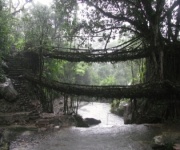
The classic route begins at Tyrna, a short drive from Sohra, and descends through thousands of stone steps toward Nongriat. The principal attraction is the Double-Decker Living Root Bridge, formed by guiding the roots of rubber fig trees across a stream over many years. The bridge is a living example of Khasi environmental knowledge rather than a conventional man-made structure.
Most visitors complete the descent and return in one long day, but a two- or three-day stay offers a much better experience. Sleeping in Nongriat allows trekkers to visit Rainbow Falls early, when the trail is quieter, and explore nearby streams without rushing back up the steps. The route to Rainbow Falls is more rugged, with slippery rocks and sections that require careful balance.
An extended version can include Nongthymmai and other nearby hamlets, depending on local trail conditions and guide availability. These villages offer a closer view of farming, forest use, and everyday Khasi life. The route is strenuous because of the elevation changes, but it is accessible to travelers with reasonable fitness who are comfortable walking for several hours each day.
The Southern Sohra Village Circuit
A southern circuit links Sohra with viewpoints, forest paths, village roads, and the approaches to Laitkynsew and Nongriat. Rather than following one universally marked trail, this itinerary is best arranged as a guided combination of footpaths and short vehicle transfers. It works well for travelers who want several days of walking without repeating the same descent and ascent.
A possible plan starts around Sohra and continues toward Laitkynsew, where rural scenery and broad valley views replace the concentration of tourist sites near town. The following day can focus on trails leading toward the Nongriat area, with an overnight stay in a village homestay. A final day can be reserved for the living root bridge region before returning to Sohra or continuing by road.
This route is especially valuable for photographers and slow travelers. Early mornings often bring low clouds across the valleys, while late afternoons can reveal layered ridges and distant plains. Because accommodation and trail access vary between villages, the itinerary should be confirmed locally rather than treated as a fixed, signed long-distance path.
For travelers who prefer an organized stay with transport, accommodation, and sightseeing combined, a four-night Sohra package can provide a practical framework around which guided walking days may be arranged. Trekkers should still request details about the walking portions, guide services, and seasonal access before booking.
The David Scott Trail Extension
The David Scott Trail is one of Meghalaya’s best-known historic footpaths. It follows an old route associated with British-era travel between the Khasi Hills and the plains, passing through rolling grassland, forest, streams, and traditional settlements. The most commonly used section runs between Mawphlang and Lad Mawphlang, north of the main Sohra attractions, so it should be treated as a regional trekking extension rather than a trail that begins in central Sohra.
A two-day version can combine a transfer from Sohra to the trailhead, a full day of walking, and an overnight stay near the end of the route. A longer plan may add village walks and nearby forest viewpoints before returning to Sohra. Some itineraries connect the David Scott section with other Khasi paths, but these connections are not always obvious or consistently maintained.
The trail is less about dramatic waterfalls and more about open highland scenery, history, and cultural landscapes. It can be a good choice for travelers who want a moderate long-distance walk after visiting caves and falls. Even so, a guide remains useful because alternative paths, private land, stream crossings, and weather-related diversions can affect the route.
| Route | Typical duration | Main experiences | Difficulty | Best suited to |
|---|---|---|---|---|
| Tyrna–Nongriat–Rainbow Falls | 2–3 days | Living root bridges, forest streams, village homestays | Moderate to strenuous | First-time multi-day trekkers with good fitness |
| Southern Sohra village circuit | 2–3 days | Rural Khasi settlements, valley views, forest paths, Nongriat region | Moderate to strenuous | Slow travelers and photographers |
| David Scott Trail extension | 2 days, or longer with additions | Historic path, grassland, villages, highland scenery | Moderate | Hikers seeking history and a quieter trail |
Comparing Terrain, Time, And Facilities
The Nongriat route has the clearest reward-to-effort relationship. The Double-Decker Bridge is an extraordinary destination, and staying overnight makes the route more comfortable than attempting the entire journey in a rushed day. However, the many steps place significant pressure on knees, especially during the climb back toward Tyrna.
The southern circuit offers more flexibility but less standardization. It may include road transfers between trail sections, and the quality of accommodation can differ from one village to another. Its strength is variety: travelers experience viewpoints, agricultural landscapes, forest tracks, and the living-root-bridge area within one itinerary.
The David Scott extension is generally less stair-heavy and can feel more spacious. Its main considerations are transport coordination and route interpretation. Travelers expecting a continuous waterfall trail may find it quieter than the Nongriat route, while those interested in landscapes and local history may consider that its greatest advantage.
Planning A Safe Trek
A local guide should be part of any multi-day plan, particularly when the itinerary leaves the main tourist roads. Guides help with navigation, village permissions, river crossings, meal arrangements, and changes caused by rain. They also make it easier to communicate respectfully with communities and identify trails that may be temporarily unsafe.
Pack light but prepare for both heat and rain. Quick-drying clothing, a waterproof layer, a small towel, and sturdy shoes with reliable grip are more useful than heavy luggage. A headlamp, reusable water bottle, basic first-aid supplies, insect repellent, power bank, and dry bags are also worth carrying.
Visitors should keep their schedule conservative. A route that appears short on a map may take much longer because of steps, mud, photographic stops, and changing weather. Start early, tell your accommodation or guide where you are going, and avoid entering swollen streams. Carry some cash because card payments and ATMs are unlikely in remote villages.
Responsible Walking In Khasi Country
The living root bridges and village trails are part of active community landscapes, not theme-park attractions. Walk quietly through settlements, ask before photographing people or homes, and follow local instructions around bridges, farms, shrines, and private paths. Buying meals or staying in locally run homestays helps distribute tourism income beyond the main town.
Waste management is particularly important in areas with limited collection services. Carry back snack wrappers, bottles, batteries, and toiletries, and avoid using disposable plastic wherever possible. Do not carve names into roots or rocks, remove plants, disturb wildlife, or use soap directly in streams.
Respect also extends to timing and clothing. Modest, practical clothing is appropriate in villages, and trekkers should avoid treating local residents as part of a staged experience. A considerate pace, small groups, and advance communication with hosts help preserve the character of these routes.
Choosing The Right Trek
The ideal itinerary depends on the kind of walking experience you want and how much physical effort you enjoy. Use these guidelines when selecting a route:
- Choose Nongriat if living root bridges and rainforest waterfalls are your main priorities.
- Choose the southern Sohra circuit if you want village stays, varied scenery, and a flexible route.
- Choose the David Scott extension if historic trails, open hills, and moderate walking appeal to you.
- Allow an extra day when traveling during wet weather or when connecting separate trail areas.
- Arrange a local guide, village accommodation, and transport before leaving Sohra.
Sohra’s multi-day treks are at their best when treated as journeys through a living landscape rather than a race between attractions. Plan around the weather, leave room for conversations and unplanned viewpoints, and let local guidance shape the route. With suitable preparation, the Nongriat trails, southern village paths, and David Scott extension can turn a Meghalaya holiday into an immersive walking adventure. Contact a trusted local tour operator to build a guided Sohra itinerary that matches your fitness, available time, and preferred level of comfort.