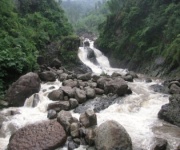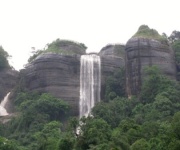






Forest trails leading to hidden waterfalls near Cherrapunjee
Cherrapunjee sits tucked into the southern edge of Meghalaya's Khasi Hills, a corner of India where the cliffs drink the southwest monsoon and the rainforest floor never quite dries out. Travellers landing in Guwahati or Shillong quickly learn that the wettest place on Earth is not a single viewpoint but a network of moss-clad ridges and gorges pouring water in every direction. The waterfalls are famous, but the forest hikes threading toward them are what stay with most visitors long after the holiday ends.
What makes these treks different from the postcards is their hidden quality. Many of the most beautiful cascades lie half a kilometre off the main tracks, reached by slippery clay steps, bamboo ladders, and the occasional hand-cut tunnel through limestone. The reward is usually a private plunge pool or a curtain of water falling from a fern-framed cliff, often with no other soul around for hours.
For travellers from Australia, the region offers a sharp shift in climate and culture that contrasts nicely with the dry summers of Perth or the salt-edged coasts of Sydney. Direct flights from Melbourne and Brisbane now connect to Kolkata, with onward road transfers into Meghalaya. The route suits anyone who has already explored Bali's rice terraces or New Zealand's Milford Track and is hungry for something wilder and far less crowded.
This guide walks through five lesser-known forest hikes that lead to secluded waterfalls near Cherrapunjee, with notes on difficulty, season, and the practicalities that separate a comfortable trek from a miserable slog. Each route can be slotted into a multi-day itinerary offered by Cherrapunjee tour operators, who usually bundle transfers, guides, and homestay meals.
Trekking the rainforest corridor to Wei Sawdong
Wei Sawdong is the kind of waterfall that photographers chase with the lights still low. Three silver tiers tumble into a clear green pool framed by bamboo and wild banana, and the only way in is on foot along a forest track beginning near Mawsmai village. The trail drops gently at first through tea gardens and betel nut palms before ducking under the canopy of the Lawshynna ridge.
Once inside the thicker jungle, the air changes. The cicadas of the Khasi summer give way to frogs, the light filters through strangler figs, and the path becomes a corridor of roots and loose laterite. Most visitors reach the third cascade in ninety minutes, but the truly hidden pocket lies past a scramble of boulders about two hundred metres upstream, where a fourth stream fans out across a flat rock ledge invisible from the main viewpoint.
Australian trekkers used to the marked trails of Tasmania's Overland Track should expect less signage and far more mud. A walking pole, quick-dry pants, and shoes with proper grip are non-negotiable during the monsoon, when the path can be a shallow stream in places. The reward for the slick scramble is a quiet pool that few day visitors ever reach; budget two to four hours for the full return walk.
Climbing toward Rainbow Falls through limestone forest
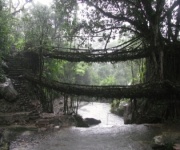
Rainbow Falls is a single veiling sheet of water crashing two hundred metres down a near-vertical limestone wall, and the jungle path toward it cuts through a pocket of primary rainforest still frequented by hornbills and the occasional leopard cat. The trailhead lies a short drive east of the main Cherrapunjee viewpoint, signposted near Nongriat and the famous double-decker living root bridge.
The first half hour is gentle, weaving between bamboo clusters and the wet clay walls of subsistence farms. The forest then thickens as the path begins to climb, crossing small streams on log bridges that wobble reassuringly underfoot. Birdsong grows louder, and the smell of damp moss and fermenting leaf litter is the kind of green scent no eucalyptus grove back in the Dandenongs can quite match.
The trick on this hike is pacing. The climb looks short on the map, but the steps are uneven and the humidity sits heavy on the lungs, even for travellers accustomed to Darwin's tropical climate. Most Australian visitors underestimate how quickly they dehydrate here. Carry three litres of water between two people and a few electrolyte tablets. Allow five to six hours round trip to the falls and back, with a short detour to the Rainbow Step plunge pools if energy allows.
Following the jungle path to Nohkalikai's hidden lower pool
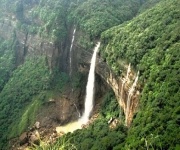
Nohkalikai is the headline waterfall near Cherrapunjee, a single 340-metre plunge that ranks among the tallest in the world. Almost every visitor walks to the main platform, but very few continue into the forest below. From the viewpoint, a narrow trail cuts down through ferns and tree ferns, dropping sharply toward a green-blue pool that sits hidden at the base of the cliff.
This is one of the few places in the area where the canopy genuinely closes over the walker. Sunlight filters through in shafts that pick out butterflies and the occasional iridescent drongo. The track is rough, partly man-made and partly carved by water, with short sections where a rope handrail is essential. Anyone with knee issues should think twice about the climb back up.
For Australians visiting between June and September, this stretch can be slippery enough to feel almost alpine, similar to a damp morning on the Larapinta Trail. The reward is a swimming hole with the full cliff face rising above you, often empty even on busy weekends because most tourists never realise the route exists. Plan the descent for late morning, when the spray lifts and the pool turns that particular shade of jade.
Wandering the misty forest toward the Seven Sisters
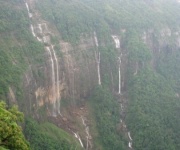
The Seven Sisters is a ridge of seven parallel streams falling in a long curtain down a bare cliff face, and the best way to appreciate them is from the forest track that runs along the rim above. The trail begins at Mawkyrnot, about an hour's drive west of central Cherrapunjee, and threads through pine and broadleaf forest for most of its length.
The walk itself is moderate rather than strenuous. The path undulates across a sandstone ridge, with occasional glimpses of the Bangladesh plains on clear afternoons. What makes this route special is the combination of open forest and cliff-edge panoramas, with the seven cascades sliding into view through gaps in the trees. It feels more like a high-country wander through the Blue Mountains than a typical rainforest trek.
Rainfall is the main variable. During the heavier monsoon weeks of July and August, the cliff path can be reduced to a thin, slippery ribbon with sheer drops close to the trail's edge. From October to February, the same track is firm and forgiving, and the Sisters run a softer silver rather than roaring white. Most guided walks include a stop at a nearby limestone cave; ask your guide which caves remain open to visitors, as some are still considered sacred.
Living root bridges and the waterfalls they shelter
The living root bridges of the Khasi Hills are grown rather than built, coaxed over generations from the aerial roots of fig trees. The most famous examples sit near Nongriat and Riwai, and each one has a hidden waterfall within a short walk. This combination of bio-engineered bridge and secluded cascade is the signature experience of any Cherrapunjee forest itinerary.
The trek to the Riwai root bridge is the gentler option, a forty-minute loop through a village orchard and across a small stream. From the bridge, a lesser-known side trail climbs to a cascade called Umngot, where a single column of water drops into a circular basin framed by ferns. The site sees almost no crowds, especially outside the busy Indian holiday weeks.
The double-decker bridge at Nongriat is the longer commitment, involving roughly three thousand steep steps down and back up through the forest. Most trekkers stop at the bridge itself for photographs, but the cascades a few hundred metres upstream, past bamboo groves and wild pepper vines, are what the locals love. Browse a photo album before you go to set expectations on the look of these crossings. Either route pairs naturally with a Cherrapunjee tour that includes village homestays and meals.
| Hike | Distance return | Time | Best season | Highlight |
|---|---|---|---|---|
| Wei Sawdong | 5 km | 2-4 hours | Oct-May | Hidden fourth cascade |
| Rainbow Falls | 8 km | 5-6 hours | Oct-Feb | Limestone forest ascent |
| Nohkalikai lower pool | 4 km | 3-4 hours | Nov-Apr | Swim at cliff base |
| Seven Sisters ridge | 6 km | 3-5 hours | Oct-Feb | Seven-stream panorama |
| Riwai root bridge | 3 km | 2-3 hours | All year | Living bridge and pool |
Practical notes for Australian travellers
These small adjustments often make the difference between a smooth trip and a difficult one when walking in Cherrapunjee's forests, drawn from feedback by visitors based in Sydney, Melbourne, and the smaller capitals.
- Carry small rupee notes for village entry fees; Australian cards are rarely accepted beyond larger hotels in Shillong.
- Pack a lightweight rain shell even in the dry months, as afternoon showers still arrive without warning.
- Bring strong mosquito repellent, since the local strains are persistent around stagnant pools.
- Allow at least one buffer day between long treks to avoid compounding fatigue.
- Confirm mobile coverage with your provider before leaving Guwahati, as signal drops inside the forest valleys.
When to go and what to expect from the weather
Cherrapunjee's climate is the opposite of Australia's. Where Sydney shivers through a chilly July, Meghalaya is being drenched by the early monsoon, and where Perth swelters in January, the Khasi Hills are enjoying clear skies and cool forest air.
- October, November, December, February, and March are the most reliable months for forest hikes.
- January brings foggy mornings but also the quietest trails of the year.
- June and September deliver the heaviest rainfall, raising landslide risk on approach roads.
- Forest temperatures sit between fifteen and twenty-five degrees Celsius almost year-round.
- Layering is more useful than a single heavy jacket, and a beanie helps on the higher ridges.
Ready to plan a route that mixes rainforest walks, hidden waterfalls, and village homestays? The team behind Cherrapunjee curates two- to seven-night packages that bundle transfers, guides, and accommodation to match a season and a fitness level to the right set of forest hikes. Reach out through the Cherrapunjee website to start sketching an itinerary that fits your travel dates.