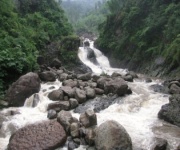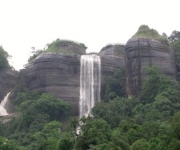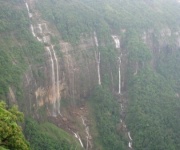






The waterfalls of the East Khasi Hills beyond Cherrapunjee
Cherrapunjee, also called Sohra, is often approached as a single dramatic stop: arrive, see Nohkalikai Falls, photograph the green escarpment and continue north. Beyond Cherrapunjee, the East Khasi Hills contain a wider world of waterfalls through steep valleys, cave country and forested ridges, linking places such as Krang Suri, Rainbow Falls, Seven Sisters, Arwah Cave and the Nongriat root bridges. Distances are generally manageable, but each place changes after rain and demands its own pace.
Choosing between a high viewpoint and a forest walk changes the experience completely. Nohkalikai is sheer and thunderous; Seven Sisters is a stepped wall viewed from a ridge; Krang Suri has a tactile, close-to-the-stream setting. The same day can therefore include morning mist, afternoon waterfall spray and a late walk through villages whose paths are held together by living roots. For Australian visitors, these contrasts are easier to enjoy when transport, guides and weather contingencies are booked together rather than improvised at each junction.
From Sohra into the wider waterfall landscape
East Khasi geography is compact but not uniform. Sohra sits close to the Meghalaya–Bangladesh border, while Nongriat lies in a valley to the south and the Jaintia Hills begin towards the east. Rainbow Falls, close to Nohkalikai, is usually catalogued in Jaintia Hills even though it appears on many Cherrapunjee-area itineraries. This matters when confirming permits, road conditions and pickup points: nearby waterfalls can be separated by a steep descent, a one-way bridge or a village access road.
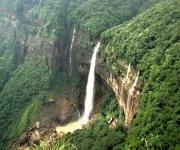
Nohkalikai Falls plunges roughly 340 metres in a narrow cleft, with the volume swelling dramatically during monsoon runoff. The Nohkalikai legend adds a local story often described as a tale of jealousy, tragedy and enduring loss. Hearing that account beside the viewing platform gives the site more depth than a quick photo stop, although the walk down is steep and the spray can make the return climb exhausting.
Krang Suri is a short but active trek through a forest reserve, reached by a hanging bridge and a descending path beside the stream. Swimming near the plunge is not permitted because currents remain dangerous. Rainbow Falls is usually added on the Nohkalikai road, while the Seven Sisters viewpoint requires a separate climb to about 1,500 metres. These are not interchangeable stops: the first rewards close contact with water, the second a wider valley view and the third altitude, haze and a long line of falling ribbons.
Choosing the best season for the cascades
Waterfall character is seasonal. The clearest window for comfortable walks is usually April to June and September to October, when paths are firmer but runoff remains strong. The southwest monsoon generally arrives from May and can continue into September, delivering Meghalaya’s famously heavy rain. Winter is drier, but cold at elevation and thinner water can reduce the spectacle. Check recent local rainfall, not only a weather app, because a storm upstream may leave a trail muddy or closed even when the forecast looks settled.
After intense rain, edges near streams can undercut, rock can become slick and access paths can turn into runoff channels. Stay on established tracks, obey barriers and do not cross water to gain a cleaner photograph. Guides are especially valuable for Nongriat’s long stair descent, cave passages and wet forest trails. Wear shoes with grip, carry a small waterproof layer and keep children close; the scale of the landscape can be deceptive, and a short distance in Meghalaya may involve a much larger vertical change than the map suggests.
Waterfalls also support distinctive forest communities and should be treated as living places rather than pure scenery. Avoid litter, loud music and entering restricted slopes; follow village guidance about sacred sites and private property. Seasonal closures may protect fragile paths or follow local conservation practice. A guide can explain why a route winds around a stream, where bathing is acceptable, and which viewpoints allow photography without blocking a trail. Those small decisions make visits less disruptive and often lead to quieter sections away from the main platforms.
Building a route from day walk to multiday escape
Start with geography rather than a wish to tick off every famous fall in one day. From Sohra, Nohkalikai and the Seven Sisters ridge work well as separate outings, with Rainbow Falls fitted into the Nohkalikai transfer when conditions allow. Arwah Cave can occupy another morning because the walk and cave interior deserve unhurried attention. If legs are tired, concentrating on one valley is better than racing between three and spending the holiday in a vehicle.
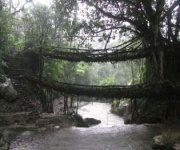
The Nongriat route requires a different level of preparation. The famous double-decker living root bridge sits beyond roughly 3,500 steps from Tyrna, and the return climbs in humid weather can be demanding. Mawsmai Cave offers a gentler cave alternative nearby, but it too depends on local guides and access conditions. Build in a morning for the walk, a midday pause and an afternoon transfer back to Sohra. The scale of the staircase also makes it unsuitable for an unplanned push to the waterfall after a long drive.
For a first visit, a multiday itinerary gives the region room to breathe and reduces pressure on the monsoon timetable. One published seven-night Cherrapunjee itinerary is useful as a model for combining Sohra scenery with the wider Meghalaya circuit rather than treating the town as a single-day excursion. Confirm what transport, guiding, meals and attraction fees are included, and ask which activities may be rearranged after rain. A flexible operator can shift a cave walk to a clearer day and preserve a waterfall visit when runoff is strongest.
Planning for Australian travellers
Australian travellers usually begin their long-haul journey through Sydney or Melbourne, then connect through a major Asian gateway such as Singapore, Bangkok or Delhi before continuing to Guwahati or Shillong. Malaysia has become a familiar first overseas destination for many Australians, and this first-time travel guide shows how a regional itinerary can make Asian travel feel approachable. The same careful mindset helps in Meghalaya: confirm every connection, allow time after a long flight and avoid treating the final local transfer as automatic. Flight combinations change regularly, so leave an overnight buffer in the gateway when the onward segment leaves from another airport. From Guwahati, road travel to Cherrapunjee can take several hours, while Shillong is a useful base for arranging a local transfer.
At home, many Australians tap a card or phone for everyday purchases and expect shops to accept digital payments; Cherrapunjee’s smaller stalls, roadside guides and rural entries are more likely to need cash. Keep a mix of small rupee notes and avoid handing over a large note when change is limited. Cherrapunjee’s local market can supply water, snacks and basic supplies, while a Coles, Woolworths or Chemist Warehouse in Australia provides a familiar way to stock sunscreen and first-aid basics. Buy insect repellent and electrolytes locally, but do not assume an Australian brand is available.
Legally, Australian passport holders who qualify for India’s tourist eVisa should verify the current category and carry both the approval and the passport used for the application; a residence address or return ticket may still be checked on arrival. An Australian driver licence does not authorise self-driving in India. Use a licensed local driver or obtain the appropriate international and Indian permissions before taking the wheel. Australian Customs rules generally allow small personal-use quantities of many medicines in original packaging with supporting prescriptions or a doctor’s letter, while specified medicines need approval.
Daily Australian habits around insurance and mobile connectivity deserve adjustment. Choose a policy that covers waterfalls, cave walks, medical evacuation and activities cancelled by weather, since standard policies can exclude trekking or hazardous falls. Download offline maps, save the hotel, guide and tour operator in local contacts, and keep a power bank because outages can interrupt charging. The Australian emergency number 000 will not work in Meghalaya; obtain the local emergency and nearest medical contacts before setting out.
A field-ready checklist for waterfall journeys
Light packing should reflect the climate, not the idea that Meghalaya is a cool hill station every day. Even in the drier months, mornings and shaded paths can be chilly, while open viewpoints become warm quickly. Light rainwear, a dry bag for phones and documents, modest clothing, reliable grip footwear and a refillable bottle cover the main needs. Add a small first-aid kit, oral rehydration salts and any prescribed medicine in its original box. Keep daypacks light enough to climb safely.
Before confirming a vehicle or guide, share mobility needs, dietary requirements and the dates on which every planned waterfall must be seen. Ask specifically about permits, entry fees, seasonal closures and what happens if a path is unsafe. Names such as Rainbow Falls and Nohkalikai can be used for different stops, so a pin on a map and a photo of the entrance are valuable booking references. This level of detail is especially useful for families and Australian visitors used to precise park and road information.
- Travel between April and June or September to October for strong runoff and generally more manageable trails, while avoiding the wettest monsoon weeks when possible.
- Keep one buffer day in a multiday itinerary so heavy rain, a landslide or a closed path can move an activity without removing the trip’s main purpose.
- Use local drivers and guides for Nongriat, Arwah and forest trails, and confirm in advance that permits, cave fees and guide charges are included.
- Wear closed shoes with strong grip, carry waterproof layers and protect phones and documents in a dry bag rather than a loose plastic bag.
- Never swim where currents or submerged rocks are present; use only clearly designated safe areas and follow local warnings at Krang Suri and other falls.
- Carry mixed-denomination cash, an offline map, emergency contacts and travel insurance that specifically covers trekking, caves, waterfalls and weather disruption.
See more than the familiar Cherrapunjee viewpoint by using the contact and booking details on Cherrapunjee.net to discuss the best route for your dates, group size and experience level, then reserve a tour or multiday package with India Beacons Sojourn. Give the operator your flight details and preferred walking pace early, so transfers, guides, permits and rainy-day alternatives can be coordinated before you arrive.