





Seven Sisters Falls and its viewpoints: a complete guide for travellers
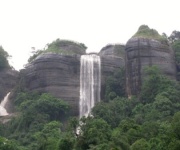
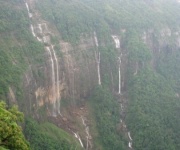
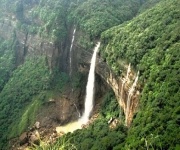
Perched in the East Khasi Hills of Meghalaya, Cherrapunjee (also called Sohra) wears the reputation of one of the wettest inhabited places on Earth, and the Seven Sisters Falls are arguably the most photographed curtain of water in the region. The waterfall is not a single drop but a segmented cascade of seven distinct streams tumbling in parallel from a mossy limestone cliff, which is precisely why the name has stuck for generations.
For travellers arriving from Australia, the journey begins in Sydney, Melbourne or Brisbane with a Qantas or Singapore Airlines connection through Singapore or Kuala Lumpur into Guwahati's Lokpriya Gopinath Bordoloi International Airport. A four-hour drive then delivers you to a town where the air smells of rain and pine, and where mobile networks are patchy but the hospitality is anything but.
The falls themselves draw visitors year-round, though their character changes dramatically between the dry winter months and the roaring monsoon season. Australians, used to the relatively tame waterfalls of the Blue Mountains or the Grampians, often describe their first glimpse of the Seven Sisters as "absolutely bonkers" — the sheer volume of water and the green saturation of the cliffs hit differently.
This guide walks through the viewpoints, access points, local folklore, and the practicalities of fitting Cherrapunjee into a broader Indian itinerary. The falls deserve at least half a day, and a few of the lesser-known lookouts reward those who linger longer.
Reaching Cherrapunjee from Australia
Most Australians flying into Northeast India transit through Singapore Changi or Kuala Lumpur before connecting to either Kolkata or Guwahati. Qantas code-shares with IndiGo and Air India make the routing manageable, and the typical one-stop itinerary from Sydney takes around 18 to 22 hours door-to-door. Travellers from Perth or Cairns usually route through Singapore.
Once on the ground in Guwahati, the choice is between a pre-booked private car, a shared sumo (the local ten-seater jeep), or a state transport bus. The drive south climbs from the Brahmaputra plains into the Khasi Hills, passing Shillong before dropping into Cherrapunjee. Aussies who love a good road trip — and who have done the Great Ocean Road or the Red Centre — often compare this drive to the most scenic stretches of Tasmania's east coast, with the bonus of roadside markets selling bamboo shoot pickles and smoked river fish.
Budget matters here. The Australian dollar stretches reasonably well against the Indian rupee, but Northeast India is still remote, so costs add up through private transport and guides. Many Australian travellers book the leg through a local operator such as Cherrapunjee.net which packages transfers, accommodation and permits into one invoice, sparing the headache of dealing with multiple agents in a language and timezone far from home.
The legend behind the Seven Sisters
The Khasis tell several origin stories for the falls, and most guides will share at least one before pointing you down the walking track. The most widely repeated version speaks of seven young women from a nearby village who fell in love with a single man from another clan. Forbidden by custom to marry him, the women are said to have leapt from the cliff in succession, their spirits becoming the seven streams that pour over the edge even today.
Another telling frames the seven streams as the tears of sisters mourning a brother killed in a tribal feud, the water carrying grief toward the plains. A more playful version, often shared with children, claims the seven streams represent the seven moods of monsoon weather, an idea any Australian who has watched a Melbourne afternoon shift from sunshine to sideways rain in twenty minutes will appreciate.
Stories shape how locals treat the site. The cliffs are considered sacred, and visitors are asked not to cross barriers or leave offerings at unauthorised spots. Respecting the rules keeps access open for everyone who follows.
Viewpoints worth knowing
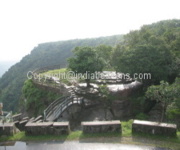
The Seven Sisters can be appreciated from several angles, and the experience changes meaningfully depending on which vantage point you choose. The most popular is the main viewing platform just off the Cherrapunjee–Mawsmai road, where a metal walkway juts out above the valley and offers the classic head-on shot. It is the easiest access, suits limited mobility, and has a small stall selling tea and maggi noodles — a quick noodle stop after the photo is a common ritual.
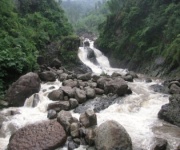
A second viewpoint lies about 800 metres down a sloped path toward the bottom of the gorge. From here you look up at the falls, and the seven streams separate visually rather than merging into a single curtain. This angle is the favourite of landscape photographers because it captures the cliff height and the layers of vegetation clinging to the rock. The path is rough and slippery after rain, so sturdy footwear matters.
Further along, a third lookout near Mawsmai opens up a wider vista including the falls in the middle distance and the Bangladesh plains when the weather clears. It is less crowded and often missed by day-trippers. A fourth, less formal viewpoint can be reached by asking a local guide along a tea-garden track, where you look sideways across the falls through terraced fields.
| Viewpoint | Access difficulty | Best feature | Crowding | Photography suitability |
|---|---|---|---|---|
| Main platform | Easy, paved | Classic head-on view of all seven streams | High | Excellent for casual photos |
| Lower gorge track | Moderate, steep | Upward perspective showing cliff height | Medium | Ideal for landscape work |
| Mawsmai vista | Easy, short walk | Wide panorama including distant plains | Low | Good for context shots |
| Tea-garden track | Variable, guide required | Side-on view framed by terraces | Very low | Atmospheric, golden hour |
Each viewpoint rewards a different kind of visitor, and combining two gives a far fuller picture than any single stop.
Timing the visit around the monsoon
Cherrapunjee's rainfall calendar is unusual by global standards. The town receives most of its annual precipitation between May and September, with June and July regularly delivering more than 1,000 mm each month. The falls are at their loudest and most dramatic during this window, but the viewpoints can be obscured by low cloud for hours at a stretch, and the lower track becomes muddy and potentially hazardous.
Most Australian visitors, particularly those travelling during the Australian winter break in June and July, end up seeing the falls at peak flow. The trade-off is spectacular volume and the chance to see the seven streams running white and full, with mist rising from the gorge below. The risk is spending an entire day at the viewpoint in cloud and walking away with only a grey photo.
The shoulder months of October, November, March and April offer clearer skies and safer walking. The falls are lower in volume, and some of the smaller streams may reduce to a trickle, but the surrounding greenery is at its most photogenic and viewpoints stay open longer. Australians used to planning around the school term often find the October and March windows line up with Meghalaya's best weather.
Capturing the falls and surroundings
Photographing the Seven Sisters rewards a few small decisions. A polarising filter cuts glare off the wet rocks and deepens the green of the cliffs, while a fast shutter speed freezes the individual streams. Early morning, between 6:30 and 8:00 am, offers the softest light and the cleanest air, with the bonus of fewer tour groups.
The viewpoint itself is east-facing, which means late afternoon light does not fall directly onto the falls. Most photographers therefore work the morning shoot, then spend the late afternoon at one of the side viewings. Telephoto lenses help isolate individual streams, while wider lenses pull in the cliff face and the surrounding forest canopy.
If you are filming for social media, the audio is half the story. The roar during monsoon is so loud that conversation requires raised voices, and ambient sound carries far better on video than any still image can convey. A small windshield helps in the wind that funnels up through the gorge.
Extending the day around the falls
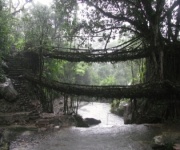
The Seven Sisters are rarely a standalone stop, and the surrounding attractions fill a half-day comfortably. Mawsmai Cave, a five-minute drive away, is a short limestone cave walked without a guide, and the Arwah Cave nearby extends further for those with torches. Living root bridges are the other headline attraction, and a half-day trek from Nongriat leads to one of the most photographed examples in the region. Australians who have hiked the Three Capes Track or the Larapinta will find the terrain comparable in difficulty, though the wet conditions and 3,500-plus steps make it more demanding than a Blue Mountains day walk. The reward is a hand-grown bridge trained over generations.
Back closer to the falls, the town of Cherrapunjee itself has a handful of viewpoints, including the Eco Park and the Nohkalikai Falls lookouts, which work well as a circuit on the same day. A useful plan sees the main Seven Sisters viewpoint first thing in the morning, a Mawsmai Cave stop mid-morning, lunch in town, and either the living root bridge trek or a wider viewpoint loop in the afternoon.
What to pack for the viewpoints
- A light rain jacket that handles both drizzle and sudden downpours
- Sturdy walking shoes with grip, not thongs or fashion trainers
- A microfibre towel for wet seats, railings, or accidental slips
- A dry bag or zip-lock for phones, wallets and passports
- A small torch for cave extensions or unexpected late returns
- Reusable water bottle — the local tap water is not safe to drink
Practical pointers before you go
- Carry small rupee notes; many viewpoint stalls do not have card facilities
- Mobile data is patchy; download offline maps before leaving Shillong
- Permits are not required for the main viewpoints, but some side tracks pass through community land and ask for a small fee
- Mornings are clearer than afternoons during monsoon season
- Always check in with your hotel before heading out, as cloud cover can shift within minutes
The Seven Sisters Falls are the kind of place that lands differently on every visitor. Some stay an hour, take the classic photo, and move on; others spend a full day walking between viewpoints, watching the light change. Either approach rewards the effort, and the falls tend to leave a stronger impression than the brochures suggest.
If a Meghalaya itinerary is taking shape, this short Cherrapunjee roundup covers the surrounding highlights in one place, and the booking team behind Cherrapunjee.net can stitch together transfers, stays and viewpoints into a single confirmed plan. The cliffs will be waiting.