





A guide to the rare orchids and flora of the Khasi Hills
The Khasi Hills of Meghalaya are shaped by cloud, rain, limestone, and forest. Around Sohra, also known as Cherrapunji or Cherrapunjee, wet cliffs and shaded valleys create habitats for orchids, ferns, mosses, rhododendrons, medicinal plants, and many lesser-known wildflowers. The vegetation changes quickly with elevation, exposure, and moisture, so a short drive can reveal several distinct plant communities.
Orchids are among the most captivating plants found here, but they are only one part of the region’s botanical character. Some grow on tree branches as epiphytes, taking moisture and nutrients from the air and accumulated organic matter. Others are terrestrial species rooted in leaf litter, mossy soil, or grassy slopes. Their flowers may be delicate and brightly coloured, while their leaves and growth habits can be just as remarkable.
A visit focused on flora rewards patience rather than speed. Look closely at tree trunks, damp rock faces, fallen logs, roadside banks, and forest clearings. Local guides can help identify plants responsibly and explain how Khasi communities use, protect, and understand the landscape.
Why the Khasi Hills support such varied plant life
The hills receive heavy rainfall, especially around Sohra, where monsoon clouds rise against the plateau and release moisture over valleys and escarpments. Rain is only one part of the ecological story. Mist, cool nights, deep shade, exposed ridges, and seasonal changes in water availability produce a mosaic of habitats.
Limestone formations add another layer of variety. Caves, sinkholes, cliffs, and mineral-rich soils create conditions that differ from nearby acidic forest soils. In sheltered ravines, moisture remains high for much of the year, allowing mosses, liverworts, ferns, and shade-loving flowering plants to thrive.
The surrounding forests have also been influenced by traditional land management. Sacred groves, protected patches of woodland maintained by Khasi communities, preserve mature trees and undergrowth that may have disappeared from more disturbed areas. These groves are valuable for cultural reasons as well as for their living collections of native flora.
Orchids to look for in forest and meadow
Meghalaya is recognised as an important orchid region, with species belonging to many genera. Depending on habitat and season, visitors may encounter dendrobiums, bulbophyllums, coelogynes, cymbidiums, erias, and the fragrant foxtail orchid, Rhynchostylis retusa. The exact species visible on a trip depends on flowering cycles, rainfall, altitude, and the condition of the forest.
Many orchids are epiphytes. They attach themselves to branches or rough bark without taking food directly from their host tree. Their roots absorb moisture from rain and mist, while decaying leaves and particles provide nutrients. This makes old trees especially important: removing mature branches or collecting plants can destroy an entire miniature habitat.
Terrestrial orchids can be harder to spot because their leaves may blend into grass or leaf litter. Their flowers may appear for only a brief period, sometimes after a change in rainfall. A guide who knows local flowering times can make a quiet walk far more rewarding than searching quickly along a busy roadside.
Orchids should be admired in place. Removing a plant from the wild can cause serious damage, and many species do not survive transplantation. Even fallen specimens should not be taken from protected forests, sacred groves, or private land without permission.
Ferns, mosses, and flowering companions
The damp ravines of the Khasi Hills provide excellent conditions for ferns. Tree ferns, filmy ferns, maidenhair ferns, and climbing species occupy different levels of the forest, from wet banks to shaded trunks. Their fronds can remain fresh through much of the year, although their appearance changes with rainfall and local exposure.
Mosses and liverworts form soft carpets on rocks, tree bark, and fallen wood. These small plants help retain moisture, reduce erosion, and create germination sites for other species. In misty weather, their textures become especially vivid, turning an ordinary trail into a detailed botanical scene.
Flowering plants add colour beyond the orchid family. Rhododendrons may brighten higher or more open slopes, while balsams, begonias, impatiens, lilies, and wild gingers grow in moist woodland and meadow habitats. Pitcher plants are another notable feature of Meghalaya’s flora, particularly in suitable wetland and grassland areas. Their insect-trapping leaves are an adaptation to soils where nutrients can be limited.
The best way to observe these plants is to slow down. Instead of looking only for large flowers, examine leaf shapes, tendrils, aerial roots, seed capsules, and the relationship between each plant and its surroundings. A small hand lens can reveal details that are invisible at normal viewing distance.
Habitats and places for botanical encounters
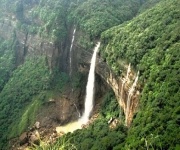
Sohra’s waterfalls and forest trails offer more than dramatic scenery. Around places such as Nohkalikai Falls, Seven Sisters Falls, Wei Sawdong, and nearby viewpoints, wet rock faces and forest edges support mosses, ferns, grasses, and seasonal flowers. Access conditions can change during heavy rain, so walking routes should be checked locally.
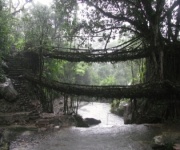
The living root bridges near Nongriat represent a remarkable relationship between people and plants. Khasi communities guide the aerial roots of rubber fig trees across streams, gradually forming strong natural crossings. These bridges are cultural structures as well as living examples of plant growth, patience, and traditional ecological knowledge.
Sacred groves, including the well-known grove at Mawphlang, are especially significant for understanding native woodland. Entry customs and local rules should be respected, and visitors should avoid touching, collecting, or rearranging anything. The value of a sacred grove lies in its continuity as a protected ecosystem, not in individual specimens taken away as souvenirs.
Caves and limestone forests support their own microhabitats. Near entrances, filtered light and high humidity encourage ferns, mosses, and shade plants, while deeper areas become unsuitable for most green vegetation. Staying on established paths protects both the fragile cave environment and the surrounding forest floor.
| Habitat | Plants and features to notice | Best approach |
|---|---|---|
| Moist forest | Epiphytic orchids, ferns, mosses, wild gingers | Scan trunks, branches, and shaded banks |
| Grassland and open slopes | Pitcher plants, balsams, lilies, seasonal herbs | Visit with a local guide and avoid trampling |
| Limestone ravines | Ferns, liverworts, orchids, hanging roots | Walk carefully on wet or uneven ground |
| Sacred groves | Mature trees, fungi, understory plants | Follow community customs and marked routes |
| Stream valleys | Living root bridges, mosses, riparian vegetation | Allow extra time for steep paths and crossings |
| Forest edges | Rhododendrons, begonias, climbers, grasses | Observe from paths rather than entering beds |
When to see flowers and how to prepare
The monsoon transforms the Khasi Hills into a saturated green landscape. Ferns, mosses, fungi, and many moisture-loving plants are particularly impressive during and after the rains. Trails can become slippery, waterfalls may be powerful, and cloud cover can reduce visibility, so sightseeing plans should remain flexible.
The drier and cooler months are often more comfortable for longer walks. Forests may be easier to explore, while some orchids and other seasonal plants flower according to local conditions rather than a fixed calendar. Anyone travelling for a particular species should treat flowering information as approximate and confirm it with a knowledgeable local source.
Comfortable clothing is important in every season. Quick-drying layers, a light waterproof jacket, sturdy shoes with good grip, and spare socks are practical choices; this guide to what to wear explains how rain, temperature, and local expectations can affect what you pack. A small daypack should also hold drinking water, insect repellent, sun protection, and a waterproof cover for photography equipment.
Avoid wearing strong fragrances in sensitive habitats, and do not use bright flash photography close to insects or wildlife. A notebook, plant identification app used offline, and a phone or camera with a macro setting can help document observations without disturbing the plants.
Responsible orchid and flora watching
Rare plants are vulnerable because their populations may be naturally small and separated across difficult terrain. Habitat loss, road construction, fire, uncontrolled tourism, illegal collection, and changes in rainfall can all affect them. A single attractive orchid taken from the wild may represent years of growth and may be part of a much larger ecological relationship.
Stay on designated trails wherever possible. Do not pull flowers, break branches, peel bark, dig up roots, or move moss-covered stones. Avoid placing bags or tripods on vegetation, and check footwear for seeds or soil before moving between sensitive habitats. These simple actions reduce the spread of invasive species and protect fragile ground cover.
Local knowledge is essential. Hire a guide familiar with the trail, ask permission before entering community-managed areas, and follow instructions at sacred groves and private sites. Buying legally propagated orchids from a reputable nursery is a better option than purchasing plants of uncertain origin from roadside sellers.
Photography can support conservation when it records habitat and seasonal change without revealing the precise location of especially vulnerable species. Sharing general information about the Khasi Hills is helpful; publishing exact coordinates of rare plants may expose them to collectors.
Practical recommendations for a flora-focused trip
- Choose a slower itinerary with time for forest walks, rather than trying to visit every waterfall in a single day.
- Arrange a local naturalist or experienced guide for orchid identification, sacred groves, caves, and community-managed trails.
- Carry waterproof layers, grippy walking shoes, water, a first-aid kit, and a phone or camera protected from rain.
- Photograph plants without touching them, and record the habitat, date, and approximate location in a field notebook.
- Support local homestays, guides, nurseries, and conservation-minded operators that benefit communities near the forests.
A botanical visit can be added to a wider Meghalaya holiday, combining Sohra’s waterfalls with living root bridges, caves, viewpoints, and village landscapes. Multi-day travel also increases the chance of seeing plants in different habitats and weather conditions instead of relying on a rushed roadside stop.
The most memorable discoveries are often quiet ones: an orchid emerging from mossy bark, a fern unfurling beside a stream, or a pitcher plant hidden among wet grass. Treat the Khasi Hills as a living ecosystem rather than a collection of attractions, and every walk becomes more meaningful.
Plan your journey to Sohra with time for careful observation, local guidance, and respectful exploration. Cherrapunjee.net can help travellers choose suitable stays and vacation packages while discovering the forests, waterfalls, caves, and remarkable flora of the Khasi Hills.