




Capping your Cherrapunjee holiday with a Mawkdok Viewpoint sunset
Every traveller knows that the final evening of a holiday carries an unusual weight. The packing is mostly done, the laundry is sorted, and the mind begins shifting back toward the rhythms of ordinary life. For visitors to Cherrapunjee, that last night offers one of the most cinematic curtain calls anywhere in the Indian subcontinent: a slow descent of golden light over the Khasi Hills from the Mawkdok Viewpoint.
Travellers flying out of Australia often plan their journey so that this final evening falls on a day with a clear western horizon. From Sydney or Melbourne, the long-haul flights into Guwahati tend to arrive in the late afternoon, and most packages build in enough buffer time to make the drive up to Sohra before the climax of the trip. There is a quiet satisfaction in timing your itinerary so that the last impression you carry home is not a hotel corridor or an airport lounge, but the layered ridges of Meghalaya glowing pink and amber as the sun drops toward Bangladesh.
What makes the Mawkdok Viewpoint special is the way the entire landscape seems to have been arranged for a final bow. The deep gorge below, the distant plains, and the gentle curve of the plateau all conspire to frame a sunset that feels both vast and personal. Even travellers who are usually indifferent to dramatic vistas tend to fall quiet here, simply because the scale of the place demands it.
Reaching the Mawkdok Viewpoint from Cherrapunjee town
The drive from Cherrapunjee town to the Mawkdok Viewpoint is short enough to fit comfortably into a late-afternoon schedule. The road winds down from the Sohra market area, passing small roadside stalls selling fresh ginger, bamboo shoots, and pineapples grown in the surrounding villages. Visitors who have spent their mornings chasing waterfalls and their afternoons exploring limestone caves will find this final leg of the journey a gentle, scenic coda rather than another full expedition.
Drivers in Meghalaya are accustomed to the rhythm of tour groups heading up to the viewpoint for the closing of the day. Most local operators will know exactly how long the journey takes and will suggest a departure time that arrives with perhaps forty minutes to spare. That buffer is useful, because the viewpoint itself has several informal parking areas, and the best photographic positions are often taken early by returning photographers who have come up specifically for dusk.
For Australians planning their trip, it is worth noting that this drive is far less demanding than the dramatic switchbacks some might associate with mountain travel. The road is well maintained, the gradient is manageable, and there are occasional pull-offs where you can step out and breathe in the cool, damp air that makes Cherrapunjee famous. Anyone who has driven through the Dandenong Ranges outside Melbourne or the winding roads near Hobart's Mount Wellington will find the experience familiar in spirit, though the surrounding vegetation feels distinctly subtropical.
Timing your arrival for golden hour
Because the sun sets quickly once it dips behind the western hills, arriving too late can mean missing the most photogenic minutes of the day. The golden hour at Mawkdok tends to begin roughly an hour before sunset and lasts for perhaps thirty minutes once the colour truly begins to deepen. Travellers who arrive ninety minutes ahead of time give themselves room to find a comfortable spot, settle in with a warm drink from the small kiosks near the edge, and watch the transformation gradually unfold.
The monsoon and post-monsoon seasons bring their own complications. Mist can roll across the gorge without warning, briefly erasing the distant plains before drifting away again. Some visitors find this atmospheric interruption frustrating, but many seasoned photographers treat the moving fog as part of the show. The interplay between the bright horizon and the shifting vapour creates scenes that no two evenings ever quite repeat, and that unpredictability is part of the viewpoint's appeal.
Australian travellers, used to the brilliant dry-air sunsets of places like Uluru or the coastal cliffs of Western Australia, sometimes arrive expecting the same kind of unobstructed clarity. The skies over Mawkdok are softer and more layered, and adjusting expectations actually enriches the experience. A wide-brimmed hat, a light layer for the cooling breeze, and a phone or camera with a reliable low-light setting will do most of the work. Some visitors bring a small thermos of tea from their hotel, an easy comfort that also helps the slow minutes pass more pleasantly.
The landscape you will see from the edge
Standing at the railing, the eye follows a sequence of distinct landscapes. Immediately below lies the deep cleft of the gorge, often filled with a slow drift of cloud that mirrors the misty mornings Cherrapunjee is famous for. Beyond that, the land softens into rolling hills, then opens into the broad plains visible on a clear day stretching toward Bangladesh. The vastness of the view is what gives the Mawkdok Viewpoint its reputation as one of the most cinematic sunset spots in Northeast India.
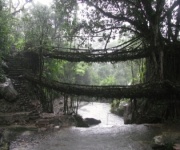
What often surprises visitors is the layered quality of the light. As the sun lowers, each successive ridge takes on a slightly different hue, moving from green to bronze to deep violet. Photographers who have spent the rest of their trip capturing waterfalls and living root bridges sometimes discover that this final vista becomes the image they frame and hang on the wall when they return to a flat in Brisbane or a townhouse in Perth. There is something about the way the plateau arranges itself here that translates beautifully into a single, balanced composition.
If you have already explored the more famous cascades around town, you may want to ask your guide about quieter corners of the district for the morning after. Hidden waterfalls beyond the tourist maps often reward travellers who have an extra day to spare, and they pair naturally with the slower pace of a trip that ends with a sunset rather than a rushed checkout.
Paragliding and other final-day activities
The Mawkdok Viewpoint is not only a place to stand and watch. On suitable days, paragliding operators run tandem flights from the rim of the gorge, offering visitors the chance to drift down toward the valley floor as the light shifts. For travellers who want their final evening to carry a small dose of adrenaline, booking a flight in the late afternoon is an ideal way to combine sightseeing with a memorable activity. The tandem pilots are used to working with first-timers, and the launch site is only a short walk from the main viewpoint platform.
Those who prefer to keep their feet on the ground often spend the half-hour after sunset browsing the small market stalls that appear near the parking area. Local vendors sell honey, Khasi spices, handwoven shawls, and fresh fruit that travellers can pack into their luggage without difficulty. Many visitors also take the chance to try a bowl of jadoh or doh khlieh from one of the food stalls, a fitting regional meal to mark the end of a Meghalaya holiday. The evening air stays mild, and conversations with the vendors often produce recommendations for future visits.
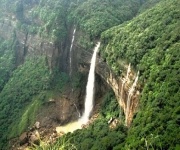
It is worth mentioning that several of the viewpoints around Cherrapunjee offer different experiences at dusk. Nohkalikai Falls is striking at any time of day, but in the late afternoon the spray catches the lowering light and creates a soft, diffused effect that photographers appreciate. Mawsmai Cave, by contrast, closes earlier in the day, so most travellers prefer to focus their final daylight hours on a place like Mawkdok where the entire evening can unfold without a fixed closing time.
A quiet farewell from the plateau
As the colour drains from the sky and the first stars appear over the Khasi Hills, the viewpoint gradually empties. Drivers begin calling their passengers back to the vehicles, and the kiosks start packing away their steel tumblers. There is a particular kind of hush that settles over a place like Mawkdok once the buses leave and only a handful of people remain. For Australians who have come from the bright, busy cities of Sydney or Adelaide, this sudden shift into quiet can feel almost luxurious.
The slow return drive to Cherrapunjee offers a moment to mentally gather the highlights of the trip. Living root bridges, dripping limestone caves, the surprising flavours of the local markets, and the sheer volume of water that pours off the plateau in every direction all replay themselves in memory. Ending the trip here, at the edge of a gorge watching the day fold into evening, gives those memories a frame they might otherwise lack. It is the difference between ending a holiday abruptly and finishing it with a deliberate pause.
Back in town, the small hotels and family-run resorts around Sohra tend to be relaxed about late arrivals. Many will keep a simple dinner warm if you call ahead, and the warmth of a meal after a chilly viewpoint can feel almost ceremonial. Travellers often sleep more deeply on that final night than on any other, perhaps because the body finally accepts that the journey is complete. The next morning, the drive down to Guwahati and onward to Australia will feel less like a loss and more like a natural continuation of something already well begun.
If you are planning a Cherrapunjee itinerary and want to make sure your final evening is treated with the care it deserves, browse the multi-day packages available through India Beacons Sojourn and consider building your trip around that closing sunset. A short enquiry through the contact page will let the team shape the route, accommodation, and onward transport around a Mawkdok finish so that the last hours of your holiday feel as considered as the first.