






Birdwatching hotspots around Cherrapunjee in the Khasi Hills
Cherrapunjee sits on the southern edge of the Meghalaya plateau, a few kilometres from the Bangladesh border, and the air here feels like it belongs to another world. Every cliff edge is dressed in ferns, every stream is overhung with figs, and the rainfall that made this town famous in colonial schoolbooks also feeds a layered mosaic of subtropical forest that birders tend to love. Long-tailed broadbills, green magpies and a steady procession of warblers move through the canopy, and the local guides treat the trails with the quiet confidence of people who have walked them for decades.
For birdwatchers used to combing the eucalyptus woodlands of New South Wales or the mangroves around Cairns, Cherrapunjee offers something different without being overwhelming. The bird list is rich rather than intimidating, the elevations are gentle, and many of the key species can be found within an hour's walk of a comfortable resort in Cherrapunjee. The trade-off is the journey: Australians will need to factor in two flight sectors and a five-and-a-half-hour time shift, since India runs five and a half hours behind Australian Eastern Standard Time, so a short, well-planned trip beats a rushed dash.
The other adjustment is the visa. Australian passport holders need an Indian e-Visa, applied for online and usually approved within a couple of working days. Print a copy, keep a soft version on your phone, and you are set for arrival in Delhi, Kolkata or Guwahati, the three main gateways that tour operators use to reach Meghalaya.
Why Cherrapunjee matters for birders
The Khasi Hills form a biological bridge between the Indian subcontinent and the Indo-Burmese region, and Cherrapunjee sits at a particularly productive crossroads. Altitudes here range from roughly 400 to 1,400 metres, which means a birder can sample lowland and mid-elevation species in the same morning. The rainfall, which averages over 11,000 millimetres a year, sustains a perpetual green that supports insects, frogs and fruiting trees, the foundation of any healthy bird community.
What makes the area special for visitors from Australia is the chance to see families of birds that are either absent or very rare at home. Babblers, laughingthrushes, bulbuls, drongos and a long list of pheasants, partridges and forest raptors all occur here. Several species are endemic to the northeast Indian hills, including the beautiful nuthatch and the rusty-bellied shortwing, and finding them gives the trip a sense of purpose beyond the usual holiday checklist.
BirdLife Australia runs regular twitchathons and camps, so there is already a community of Australian birders who chase lifers abroad. A trip to Meghalaya fits neatly into that culture, particularly for anyone who has worked through the Asian end of the Clements checklist and is looking for the trickier Eastern Himalayan taxa.
Forests above and below the plateau
The plateau itself is a mix of degraded grazing land, secondary forest, pine plantations and pockets of older broadleaf woodland that cling to ravines. Most of the commoner birds, including white-eyes, leafbirds, tits, sunbirds and flowerpeckers, can be found within a short walk of the main road, which is a relief for travellers still shaking off jet lag from a flight that started in Sydney or Melbourne.
For a more immersive session, the wooded slopes below the plateau are where things get interesting. Paths wind down through bamboo and tree fern into sheltered valleys where the air is noticeably warmer and damper. Slaty-bellied tesias, black-eared shrike-babblers and several species of forktail favour these damp hollows, and the dawn chorus here can rival anything in Lamington National Park in Queensland.
The other advantage of working the slopes is the vertical drop. A single morning can take you from open pine forest into dense subtropical growth and back, which is a useful tactic when the weather is unsettled. Even on grey mornings the lower valleys stay relatively sheltered, and you can still hear the deep hooting of the great hornbill echoing across the gorge.
Mawsmai cave fringe and Mawlynnong village
The Mawsmai and Mawlynnong area, a short drive east of Cherrapunjee, has become a popular stop on most itineraries, and for good reason. The limestone fringe forest here is structured differently from the plateau woodland, with more climbers, more figs and a higher density of understorey birds. Grey-cheeked warblers, long-tailed sibia and the occasional red-faced liocichla move through the fig-heavy patches, and patient scanning from the road often produces a small flock of mixed species.
Mawlynnong itself has been promoted as Asia's cleanest village, but the birding attraction sits in the forest that surrounds it. The short trail down to the natural root bridge passes through some of the most intact canopy in the district, and early mornings regularly produce great hornbills, oriental pied hornbills and, with luck, the rare rufous-necked hornbill.
The caves at Mawsmai should not be skipped either, even though their main draw is geological. The forest above the cave entrance holds roosting sites for barbets and lorikeets, and the edges are reliable for grey tit and sultan tit. Local guides know the staging posts well, and most are happy to pause the itinerary for a flock that lands nearby.
Living root bridge catchments
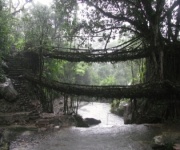
The living root bridges of Nongriat and the surrounding valleys are famous in their own right, and a side benefit for birders is the quality of forest they reveal. To reach the most photographed bridges you descend around 3,500 steps, which is enough to put off casual visitors and leave the lower forest in relative peace. For Australians used to bushwalks in the Blue Mountains or Tasmania's Federation Peak, the descent is taxing but manageable with a trekking pole and steady knees.
The birding around the bridges is excellent. The stream catchments below the village hold slaty-backed forktails, plumbeous redstarts and white-crowned forktails, all of which favour the mossy rocks at the water's edge. Above the path, the canopy is dominated by figs and laurels that feed hornbills, barbets and a rich community of frugivores.
Timing matters here, and a trip around the leaf flush tends to align bird activity with the most photogenic stage of the bridges themselves. Insect activity peaks in the warmer hours from 9 to 11 a.m., which is also when the larger hornbills come into the open to feed.
Caves, cliffs and the search for specials
Meghalaya's limestone belt runs well beyond Cherrapunjee, and the cave systems at Mawsmai, Krem Mawmluh and Arwah are surrounded by habitat that supports a quieter, more specialist bird community. The cliff faces and cave mouths attract nesting hirundines and swifts, while the surrounding scrub is good for warblers, prinias and grassbirds that Australian birders may have seen in Southeast Asia rather than at home.
Some of the most sought-after species in the district require a bit more effort. The beautiful nuthatch, the rufous-bellied niltava and the white-browed shortwing all favour particular microhabitats, often tucked into a single ravine or a stretch of bamboo. Local guides know the reliable spots and will often pick up contact calls well before the bird appears, which is helpful in dense forest where visual confirmation can be tricky.
The raptor list is also worth attention. Crested serpent eagles, mountain hawk-eagles and the occasional Besra hunt above the cliffs, and Black Eagles are seen regularly along the deeper gorges. For anyone used to scanning for wedge-tailed eagles along the Victorian high country, swapping them for an Indian raptor set is one of the real pleasures of the trip.
Comparing the best bases
Different bases suit different birding styles, and the choice tends to come down to how much walking you want versus how much driving.
| Base | Elevation | Habitat nearby | Access to sites | Best for |
|---|---|---|---|---|
| Cherrapunjee town proper | ~1,484 m | Plateau forest, ravine edges | Walking | Casual birding, short walks |
| Mawsmai village | ~1,200 m | Limestone fringe | Short drives | Fig-forest specialists |
| Mawlynnong area | ~900 m | Sub-montane, root bridges | Walking | Canopy birders, families |
| Nongriat village | ~600 m | Stream catchments | Long staircase | Hardcore walkers |
| Shillong outskirts | ~1,500 m | Pine, mixed broadleaf | Driving | First or last day birds |
Most guided tours combine two or three of these in a single itinerary, with Cherrapunjee itself and Shillong as the comfortable bookends. Travellers pressed for time tend to focus on the Cherrapunjee-Mawsmai-Mawlynnong triangle, which can be covered comfortably in three or four nights without missing any of the signature birds.
Packing light and targeting smart
A modest pack goes a long way here, but a few items pay for themselves over a week in the field. Australia's biosecurity rules mean used birding shoes, muddy notebooks and any untreated feathers should be cleaned or left behind before the return flight, so plan for that well before you close your suitcase.
Kit worth carrying
- 8x42 or 10x42 binoculars with rain covers
- Lightweight rain shell and quick-dry trousers
- Head torch with a warm beam for dawn starts in caves
- Telescopic stool for roadside scanning
- Field notebook and eBird app preloaded with Meghalaya
- Spare dry bags for camera gear and passport
Species worth prioritising
This is by no means a complete list, but it covers what most visiting birders chase first.
- Great hornbill and oriental pied hornbill
- Beautiful nuthatch and velvet-fronted nuthatch
- Long-tailed broadbill
- Rusty-bellied shortwing
- Red-faced liocichla
- Rufous-necked hornbill, with luck
Cash works better than cards in the Cherrapunjee area, so carry enough Indian rupees for two or three days at a time. Major ATMs in Guwahati and Shillong accept most Australian debit cards, and network coverage drops in the deeper valleys, so download offline maps and any eBird checklists before you leave Shillong.
Cherrapunjee rewards visitors who come between November and April, when rainfall is lower and forest access is easier. Mornings tend to start cold and brighten by 8 a.m., which is also when bird activity peaks, so most days should be planned around a 5:30 a.m. start and a long, well-earned lunch. The team running tours from Cherrapunjee can shape itineraries around your target species, group size and fitness level, and they are used to working with international visitors who arrive with very specific lists. Drop them a line before you book flights so the timing, permits and transfers line up with the best weeks of the season.