




How Meghalaya’s Living Root Bridges Grow Through Time
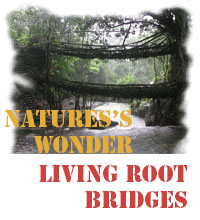
In the misty hills of Meghalaya, bridges are cultivated rather than assembled. Khasi and Jaintia communities have developed a remarkable tradition of guiding the aerial roots of rubber fig trees across streams, ravines, and steep channels. Over many years, these roots knit together into strong natural crossings that can carry people through the wettest landscapes in the region.
A living root bridge is therefore both a structure and an ongoing relationship with a tree. Its history is preserved in village knowledge, seasonal work, forest paths, and the patient care given by several generations. Unlike a bridge made from timber or concrete, it continues to grow after it becomes usable, gradually becoming thicker and more stable.
The most famous examples are found around Cherrapunjee, also known as Sohra or Cherrapunji, where exceptional rainfall has shaped the terrain. Watercourses that would quickly damage ordinary materials can be crossed by root bridges whose living fibres respond to moisture, soil, and time.
A tradition shaped by Meghalaya’s landscape
The Khasi Hills are cut by deep valleys, fast-flowing streams, and forested slopes. During the monsoon, small channels can become powerful torrents, while paths between villages may turn difficult or unsafe. Communities needed reliable crossings that could withstand heavy rain without requiring large quantities of manufactured material.
The rubber fig, or Ficus elastica, provided a natural answer. It grows aerial roots from its trunk and branches, allowing those roots to reach the ground and form additional supports. Local communities learned how to direct this growth toward the opposite bank of a stream, gradually creating a bridge where the landscape demanded one.
The practice is associated particularly with the Khasi people, although living root bridge traditions are also found among communities in the Jaintia Hills. Knowledge has traditionally been passed through observation and participation. Children learn which trees are suitable, how roots should be positioned, and when a crossing needs repair or reinforcement.
The exact age of individual bridges is often difficult to establish. Some have been maintained for several centuries, while others are younger crossings that remain part of a living network of village routes. Their history is best understood through community memory and continuous use rather than a single construction date.
The tree that makes the bridge possible
Rubber fig trees are well suited to this form of natural engineering. Their flexible aerial roots can be guided while they are still developing. Once roots reach soil, they become sturdier and begin to behave like additional trunks or cables. As more roots join the structure, the bridge gains strength and resilience.
A suitable tree usually grows close enough to a stream or ravine for its roots to be directed toward the opposite side. The tree is not cut down to provide building material. Instead, its growth is encouraged, making the living organism the central framework of the crossing.
In some areas, young roots are guided through hollowed betel nut trunks or other temporary channels. These channels act like moulds, helping the roots travel in the desired direction. Bamboo and wooden supports can also hold roots in place while they lengthen. As the roots thicken, temporary materials may decay or be removed, leaving the mature root structure behind.
The result is a bridge with a complicated internal pattern. Interwoven roots spread weight across several points rather than placing all pressure on one beam. Stones, soil, and leaf litter gradually fill gaps between the roots, while small plants and mosses may grow on the surface. The bridge becomes part of the forest ecosystem instead of standing apart from it.
How a living crossing is grown
Creating a root bridge begins with selecting a healthy rubber fig in a strategic location. Community members study the stream, its changing water level, and the slope of the banks. The starting point must be stable, and the tree needs enough strength and access to moisture to support years of guided growth.
Young aerial roots are then directed toward the desired landing point. A bamboo framework, a hollowed tree trunk, or another temporary guide may be placed across the gap. The roots are carefully threaded through this support so they do not fall into the current or grow away from the route.
The process requires regular attention. Roots may need to be repositioned after storms, tied closer together, or protected from damage caused by water and foot traffic. When a root reaches the far bank, it is encouraged to take hold in the soil. New roots can be added to strengthen weak sections and widen the walking surface.
A bridge is considered usable only after enough of its root network has become firm. Even then, cultivation continues. Residents may place stones along the deck, clear invasive growth, replace worn supports, or guide new roots into gaps. This makes the bridge a long-term communal project rather than a finished object handed over to the next generation.
Time turns roots into structure
The growth rate depends on rainfall, soil, temperature, the health of the tree, and the size of the crossing. A small footbridge may become functional within a few years, while a large bridge spanning a wider channel can require decades of care. The early period is especially delicate because young roots are vulnerable to floods and movement.
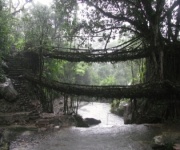
Once established, the bridge becomes stronger through continued growth. Thick roots merge, cross, and form natural joints. Some roots descend from above and become vertical supports, while others spread across the deck. The mature structure can look like a woven arch, a suspended walkway, or a dense lattice anchored on both banks.
The following stages describe the general process, although each village adapts the method to its terrain:
| Stage | Community work | Typical timescale | Developing result |
|---|---|---|---|
| Selecting the site | Identify a healthy fig and stable stream banks | One season | A safe route and growth plan |
| Directing young roots | Thread roots through bamboo, trunks, or supports | Several years | Roots begin reaching the opposite bank |
| Establishing the anchors | Encourage roots to enter soil on both sides | Several more years | The crossing gains stability |
| Strengthening the deck | Add roots, stones, and natural supports | Ongoing | A wider and more durable walkway |
| Maintaining the bridge | Clear debris and guide new growth | Every year | A living structure that can endure for generations |
This long timeline explains why a root bridge cannot simply be replicated quickly for tourism. Its strength comes from biological growth and repeated care. The patience invested by one generation creates a useful crossing for people who may live many decades later.
Community knowledge and forest stewardship
Living root bridges reveal a practical understanding of ecology. Communities work with a tree’s natural behaviour instead of forcing the landscape into a rigid design. The bridge remains connected to the soil, stream, and surrounding forest, so its maintenance depends on keeping the wider environment healthy.
The tradition also reflects cooperation. A bridge may connect homes, farms, sacred groves, and walking routes, making its value social as well as practical. Maintenance tasks can include clearing vegetation, checking roots after monsoon floods, and helping visitors cross safely. The knowledge belongs to the community that has observed the bridge across seasons and generations.
Root bridges can also reduce the need to replace timber crossings repeatedly. A wooden bridge may rot or wash away, while a well-maintained living bridge can become more secure with age. That does not make it indestructible. Excessive footfall, litter, fires, careless construction, and changes in drainage can weaken the ecosystem that supports it.
Visitors should remember that these bridges are working infrastructure and cultural heritage, not amusement installations. Walking slowly, keeping to the centre, avoiding loose roots, and following local instructions help protect both the bridge and the people responsible for it.
Visiting the bridges around Cherrapunjee
The Nongriat area is home to the celebrated Double-Decker Living Root Bridge, reached by a demanding descent and climb through forest paths and stone steps. The journey requires time, water, suitable footwear, and enough stamina for the return route. Other root bridges, including the crossing near Riwai, offer different settings and access conditions.
Weather can alter the experience significantly. Rain may make steps slippery, raise stream levels, and reduce visibility. The same monsoon conditions that sustain Meghalaya’s forests can also change a trail within hours. A local guide is valuable for route information, timing, river conditions, and cultural context.
Some areas near Cherrapunjee may involve local rules or restricted access. Before travelling beyond ordinary tourist routes, review the available permit guidance and check current requirements with an authorised local contact. Rules can help protect sensitive landscapes and clarify which paths are open to visitors.
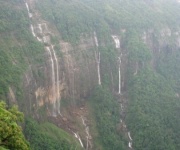
A visit does not need to focus only on reaching a famous bridge. Sohra has waterfalls, caves, viewpoints, forest walks, and village landscapes to explore. During severe rain, travellers can also plan indoor rainy-day ideas, allowing the trip to remain enjoyable without putting unnecessary pressure on wet trails.
Ways to experience the tradition responsibly
- Choose a local guide or community-recommended route for remote bridges and forest trails.
- Wear shoes with firm grip, carry drinking water, and allow extra time for steep or rain-affected paths.
- Follow village instructions, avoid climbing on railings or delicate roots, and never remove moss, plants, or pieces of the bridge.
- Carry waste back with you and use refillable containers where practical.
- Include nearby cultural and natural attractions in your itinerary so visitor activity is spread across the destination.
The living root bridges of Meghalaya are remarkable because their history is still unfolding. Each new root guided across a stream adds to a tradition that connects botanical knowledge, engineering, travel, and community life. A bridge that looks ancient may still be growing, while a young crossing already represents a promise to future residents.
Plan a Cherrapunjee journey that gives these living structures the time and respect they deserve. Explore the region with India Beacons Sojourn, choose a suitable multi-day package, and make the root bridges one part of a wider Sohra experience shaped by forests, waterfalls, caves, villages, and the enduring ingenuity of Meghalaya’s people.