



Relaxing Picnic Spots Near Cherrapunjee Waterfalls
There is a particular kind of quiet that only exists near moving water, the sort of hush that settles over a grassy bank when a distant cascade is doing all the talking. Cherrapunjee, the old Sohra tucked into the East Khasi Hills of Meghalaya, has more of that hush than almost any other place on earth. With an average annual rainfall that once held a world record and a landscape of cliffs, canyons, and root-stitched forests, this corner of northeast India offers picnic settings that feel almost too cinematic to be real. For travellers flying in from Sydney or Melbourne, the journey involves a connection through Singapore or Bangkok and a short hop up to Guwahati, but once the hill road begins climbing toward Sohra, the effort dissolves into the scenery.
Australians have always had a soft spot for outdoor dining. From the esplanades of Sydney Harbour to the wineries of the Barossa, the ritual of laying out a rug, uncorking something cool, and watching the light change is practically a national pastime. Cherrapunjee rewards that instinct with a twist: instead of eucalyptus and salt air, the backdrop is limestone gorges, bamboo groves, and water plunging hundreds of metres through cloud forest. The picnic spots near the waterfalls here are not manicured parks with concrete benches. They are wild, weathered ledges and soft mossy clearings where you can spread a blanket and let the monsoon-fed roar of the falls become the afternoon's soundtrack.
This guide is written for Australian travellers who want to combine the long-haul flight with something restorative, a day or two of doing very little near very impressive water. The spots below are arranged roughly by accessibility, from the famous viewpoints that almost every visitor sees to a couple of quieter corners that reward those willing to ask locally. Before setting out, it is worth looking over a more complete roundup of the the best spots for a picnic in Cherrapunjee to cross-check current conditions.
The Setting That Makes Cherrapunjee Special
Cherrapunjee sits on a plateau that catches the full force of the southwest monsoon, which is why the cliffs are draped in ferns and the streams run even in the dry months. The waterfalls here are not the trickle-and-pool variety of temperate regions. Many drop in single sheer sheets from two hundred metres or more, and the spray zones are their own microclimates, cool and mossy and alive with the smell of wet stone. For picnickers, that translates into natural air conditioning and a constant white noise that makes conversation feel like a private affair.
The terrain also offers something rare: flat-ish clearings with a view. Most famous waterfalls in the world force visitors to peer down from railed platforms, but around Cherrapunjee, you can often walk a short distance to a level patch of grass or a low stone outcrop where a small group can sit comfortably. The light here changes quickly as clouds roll through the valley, which is part of the pleasure. A picnic that starts under a hazy sun can end under a single bright beam, with the falls throwing a partial rainbow into the gorge below. For anyone curious about how this corner of the world compares to its closest rival for the title of wettest place on earth, the Cherrapunjee vs Mawsynram which is wetter piece lays out the surprising details.
Seven Sisters Falls and the Viewpoint Meadow
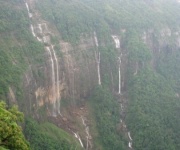
The Seven Sisters are the headline act of the region, a chain of seven segmented cascades dropping side by side into a plunging valley. The official viewpoint has the obvious wow factor, but the better picnic move is to back away from the rail and spread a blanket on the grassy slope just behind the viewing area. Here the falls are still framed by the cliff edge, but you have room to stretch out, and the sound is less of a roar and more of a steady pour. It is the sort of place that invites slow sandwiches, a flask of tea, and a long pause.
For Australians used to the wide-open lookouts of the Blue Mountains or the Grampians, the vertical drama here is a refreshing change. The valley drops away almost vertically, and the seven ribbons of water pick up different shades of white and silver as the cloud cover shifts. Bring layers even in the warmer months, because the elevation and spray can drop the temperature by several degrees compared to the plains below. A thermos of something hot earns its keep quickly.
Nohkalikai Falls and the Quiet Edge Above
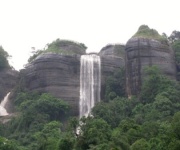
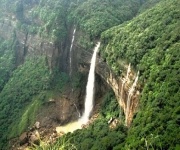
Nohkalikai is the tallest plunge waterfall in India, a single white thread falling from a forested rim into an emerald pool far below. The viewpoint is one of the most photographed spots in Meghalaya, and it draws coachloads during peak hours, which is reason enough to arrive early or late in the afternoon. The smart picnic play is to claim a spot along the rim path a short walk from the main platform, where the grass is softer and the crowd thins out. The falls remain in view, the drop is still dizzying, and the silence returns once the last tour van pulls away.
This is also one of the more contemplative spots in the region. There is a small memorial nearby connected to the falls' name, and the atmosphere leans toward reverence rather than spectacle. A picnic here feels less like a celebration and more like a pause, a place to sit with a book or a notebook and let the scale of the landscape do the work. For Australian travellers who have hiked the Overland Track or trekked in New Zealand's Fiordland, the emotional register will feel familiar: that particular humility that big water inspires.
Wei Sawdong and the Stream Beyond the Bridge
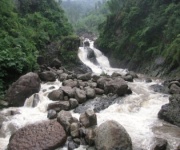
Wei Sawdong is a three-tiered falls that remains relatively under the radar, which makes it ideal for anyone who finds the main viewpoints a little too busy. The drive in passes through villages of stone houses and pine fences, and the falls themselves pour into a series of wide, shallow pools that are perfect for a spread-out picnic. The flat rocks along the lower pool stay cool even in the late morning, and the surrounding forest keeps the light soft and green.
Reaching Wei Sawdong usually means a short walk from the road and a brief local guide arrangement, which is part of the appeal. The path winds through bamboo and wild ginger, and the sound of the water builds gradually until the falls appear. Bring food that travels well, flatbread, hard cheese, dried fruit, and a bottle of something local, because there are no shops at the falls themselves. The reward is a private afternoon with one of the prettiest cascades in the district.
Mawsmai Cave and the Forest Stream Nearby
Mawsmai is the most accessible of the limestone caves in the area, a short walk from the main road with lit chambers and a constant drip of mineral-rich water. The caves are the draw for most visitors, but just above them, a small forest stream emerges from the limestone and tumbles down a series of low cascades through dense undergrowth. This is a wonderful picnic spot for travellers who want a shorter day, because the walking is minimal and the setting feels like a green tunnel.
The light here is filtered and golden in the late afternoon, and the stream is shallow enough to wade in if the mood takes you. It pairs well with a morning spent inside the caves and a late lunch on the mossy banks. Australian travellers who have explored the Jenolan Caves in the Blue Mountains will appreciate the comparison, though Mawsmai is wetter, wilder, and very much alive with the sound of running water.
Living Root Bridges and the Riverside Lunch
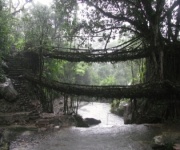
The living root bridges of the Khasi hills are the slow-art wonders of the region, grown over generations from the roots of rubber fig trees trained across streams. The most famous, the double-decker at Nongriat, requires a long descent of roughly 3,500 steps, which is not ideal for a casual picnic. The single root bridges around Tyrna and the easier walks near Mawsynram offer a gentler option, with the same strangeness and beauty at a fraction of the effort.
A picnic beside one of these bridges is a quieter kind of magic. The water is usually clear and slow, the bridges themselves look like something from a fairytale, and the surrounding forest keeps the light soft. Plan to bring a compact picnic rather than a full hamper, because some of the walks involve uneven stone steps. The sense of having lunch in a place that took fifty years to grow is hard to match anywhere else.
Practical Tips for Travellers from Australia
The time difference between eastern Australia and Meghalaya is roughly four and a half hours, which makes adjusting easier than trips to Europe. Most Australian visitors arrive via a night flight to Singapore or Bangkok and connect onward to Guwahati, with the road transfer to Cherrapunjee taking around four to five hours depending on traffic and weather. The road climbs steadily, so motion-sensitive travellers should sit on the left side of the vehicle for the better views and the gentler curves.
The climate is the main thing to plan around. Cherrapunjee lives up to its reputation, and even in the so-called dry months from November to February, light rain is possible. A compact rain jacket, quick-dry trousers, and shoes with grip are far more useful than a heavy coat. A picnic blanket that can handle damp grass, a small dry bag for phones and passports, and a thermos that keeps tea hot for hours will all earn their space in the bag.
Australian travellers often appreciate a small comparison to familiar landscapes, and there is an interesting parallel to draw with tropical garden design. The way Cherrapunjee manages water, vegetation, and viewing platforms is not unlike the way Singapore's famous horticultural park balances engineered spectacle with natural growth. Honeymooners in particular will recognise the appeal of a setting that feels both cultivated and wildly green; a guide to Singapore's Gardens by the Bay captures that same blend of the dreamlike and the planned, which is useful context for the Meghalaya leg of a longer Asian itinerary.
A Few Picnic Picks to Save
- Nohkalikai rim for the most dramatic scale and the quietest hour near sunset
- Seven Sisters viewpoint meadow for a sociable spread with the classic panoramic view
- Wei Sawdong's lower pool for a private afternoon and the option to wade in cool water
- The forest stream above Mawsmai Cave for an easy half-day with a short walk
- A single-decker living root bridge near Tyrna for a fairytale setting that pairs well with a thermos of tea
If any of these spots sound like the kind of afternoon you have been looking for, the next step is straightforward. Reach out to India Beacons Sojourn through Cherrapunjee.net to ask about tailoring a two- to seven-night package that includes the picnic stops, the transfers from Guwahati, and a choice of resort or homestay in Sohra town. The team can also advise on the right months to travel, what to pack for the monsoon edges, and how to combine Cherrapunjee with Dawki, Shillong, or the caves of Mawsmai. Lock in the dates, pack a soft blanket that can handle wet grass, and let the waterfalls do the rest of the planning for you.