





A few Khasi words that go a long way in Cherrapunjee
Learning a handful of phrases in the local language can turn a standard sightseeing trip into something that actually sticks in your memory. Travellers from Australia often arrive in northeast India carrying a backpack full of plans, a printed itinerary, and a working knowledge of Hindi they picked up from a mate in Sydney. None of that helps much in Meghalaya, where the hills around Cherrapunjee speak Khasi, an Austroasiatic tongue with roots far older than the Indo-European languages most visitors know.
Khasi is spoken by the Khasi people across the Khasi Hills and Jaintia Hills of Meghalaya, and a few related dialects reach into neighbouring Assam and Bangladesh. English is widely taught in schools, so signs, menus, and younger hotel staff will often switch to English without being asked. Even so, dropping a simple Khasi greeting into a conversation signals something that perfect grammar cannot: that you bothered.
For Australians, the timing is right. Direct flights from Sydney or Melbourne to Delhi have made the first leg of the journey cheaper and shorter than it was ten years ago, and a connecting service to Guwahati puts you within a long drive of Cherrapunjee itself. Most travellers land bleary-eyed after twenty-plus hours in the air and arrive with nothing more than "namaste" in their pocket. A few extra phrases are easy to slot in during a stopover in Singapore or Bangkok, and they pay off the moment you meet a guide, a homestay host, or the grandmother selling pineapples by the roadside.
This is not a phrasebook, and it is certainly not a course. It is a small, practical collection of words and sentences to learn on the plane, plus a few notes on pronunciation and culture so the words sound right and land well. Read it once, repeat it a few times, and you will walk into a Cherrapunjee homestay better prepared than ninety percent of visitors.
What kind of language is Khasi, anyway?
Khasi belongs to the Austroasiatic language family, the same broad group that includes Vietnamese and Khmer. That detail matters because it explains why Khasi sounds nothing like Hindi or Bengali, even though all three are spoken within a few hundred kilometres of each other. The vocabulary is unrelated, the sentence structure is different, and several of the consonant sounds will feel unfamiliar to anyone who only knows European languages.
The script used today is the Latin alphabet, which is a relief for English-speaking travellers. Most printed Khasi you encounter in Cherrapunjee, from school noticeboards to café menus, will be in Roman letters. Older texts and some Christian publications use a slightly adapted version, but you will not need that on a short trip.
Two practical things help when you start learning. First, Khasi is largely a syllable-timed language, so each syllable takes roughly the same length of time. This makes it easier to copy rhythm from a native speaker than English is. Second, tones are not used the way they are in Mandarin or Vietnamese, so pitch is not something you need to memorise. Pronunciation is mostly a matter of getting a handful of consonants right, which is where most of the work goes.
Greetings that open doors in the hills
Khasi greetings are warm, brief, and easy to copy. A handful of phrases cover almost every casual encounter, from a morning walk through the village to a meal with a host family. Learning six of them by heart will get you further than a full grammar book.
- Kumno? – "How are you?" A relaxed, all-purpose opener used at any time of day.
- Nga ia dei – "I am fine." The standard reply, regardless of how you actually feel.
- Iei ka bhai? / Iei ka kynphang? – "What is your name?" Use bhai for a man, kynphang for a woman.
- Ka jingieituh nga – "My name is…" Follow it with your name.
- Pynjur – "Thank you." Often said softly, almost under the breath.
- Khublei – "Excuse me" or a polite hello, used when entering a home or asking for attention.
Australians, who are used to saying "no worries" to anyone who looks slightly inconvenienced, will find the Khasi habit of understating gratitude oddly familiar. A quiet pynjur, said with a small nod, fits the same social space as a Melbourne barista handing you a flat white with a quiet smile.
Numbers, directions, and getting around
Counting in Khasi is simpler than it first appears, because the system is regular once you hear it. From one to ten, the words follow a clear pattern, and most numbers above ten are built from those roots in a predictable way. For a short trip, learning one through ten plus the words for "where," "here," and "there" is enough to handle taxis, shared jeeps, and a friendly argument about the price of a basket of oranges.
A few essentials: wei is one, ar is two, lai is three, saw is four, san is five. From there, hynriew (six), hynniew (seven), prah (eight), khyndai (nine), and shi (ten). The word for hundred is shi ka riew, and the word for thousand is shi ka sla. None of this needs to be perfect on day one, but a recognisable attempt earns a grin. A useful phrase to memorise before any trek around the Seven Sisters is the question "how far?" – kat ka jingjngi? – which is exactly what you will want to ask when the trail turns muddy. There is a Seven Sisters trek guide that helps with the geography; the language is the part you bring yourself.
Direction words are the other set worth memorising. Ha kane ka lynti means "this way," ha kane ka shateh means "right here," and hangne means "there." Pair them with leit, the verb for "to go," and you can build simple questions like "where does this path go?" without resorting to English.
Food words you'll hear at the market
Food is where Khasi vocabulary meets the senses, and where most travellers end up using their new words the most. Markets in Cherrapunjee and the surrounding villages sell produce you have probably never seen before, and the sellers will often switch languages the moment they hear a curious foreign accent. Knowing a handful of food words turns a passive shopping trip into an actual conversation.
- Jadoh – the famous rice and fish dish, often cooked in a single pot with pork or pork fat.
- Dohkhlieh – a pork salad with onions, ginger, and a sharp chilli hit. Not for the faint-hearted.
- Pukhlein – a sticky, slightly sweet rice flour snack sold by street vendors.
- Tungrymbai – fermented soybean side dish, used as a flavour base.
- Kwai – betel leaf with areca nut and lime, the local equivalent of a post-meal digestif.
Two phrases to pair with the food list: kat ka jingdon? means "how much does it cost?", and ka dei kaei? means "what is this?". Asking the second question while pointing at an unfamiliar vegetable is the fastest way to learn something new and make a friend at the same time. Australian travellers who grew up in places like Fremantle or Adelaide, where multicultural markets are part of everyday life, will recognise the rhythm immediately.
Pronunciation without the panic
Khasi has a small set of sounds that English does not use, and a few it uses in unexpected places. The good news is that none of them are difficult to copy if you listen carefully first. The bad news is that English speakers, including most Australians, tend to flatten unstressed syllables in a way that makes Khasi words hard to recognise. Slow down, exaggerate a little, and the sounds fall into place.
Three sounds to focus on. The "kh" at the start of Khasi words is a voiceless velar fricative, the same sound at the back of the Scottish "loch." Australian English does not use it much, but it is easy to produce: imagine clearing your throat gently while keeping the tongue low and the mouth open. The "ng" sound in Nga is the same one that begins "singing," not the "n" of "no." Finally, the "ie" in pynjur is two separate vowels, pronounced quickly, almost like "ee-uh" squashed together.
Avoid three common mistakes. Do not stress every syllable equally – English speakers often do this because they think it sounds careful, but it sounds unnatural in Khasi. Do not add a vowel to the end of consonant-final words; pynjur ends on an "r," not "ruh." And do not translate word-for-word from English phrasing; Khasi often puts verbs and question words at the end of a sentence, so the rhythm will sound reversed at first.
Respect, gestures, and things to leave alone
Language is only half of communication, and a small amount of cultural knowledge prevents the kind of awkward moment that no phrasebook can fix. Khasi communities in and around Cherrapunjee are largely Christian, particularly Presbyterian and Catholic, but traditional beliefs about nature, ancestors, and sacred groves remain strong. Visitors who show a little awareness of this usually get a warmer reception.
A few simple rules help. When entering a home, a guesthouse, or a place of worship, wait for the host to invite you in and look for the cue before removing shoes. When crossing a village, treat any fenced area marked as a sacred grove (law kyntang) as off-limits, even if it looks like ordinary forest. When greeting an older person, a slight bow of the head paired with khublei is more appropriate than a Western handshake, although handshakes are widely accepted in business and tourism settings.
Photography deserves a quick word. Not every village welcomes cameras, and not every ceremony welcomes them either. Asking nang dei ka leh? – "may I?" – is the polite way to check before pointing a lens at a person. It is a small courtesy, but it matches the broader Khasi habit of soft-spoken respect. If your travels take you beyond the well-trodden paths of Mawsmai and Arwah, the cherrapunjee-s-hidden-caves-beyond-mawsmai-and-arwah route covers some of the less-visited sites where this kind of quiet awareness matters most.
Putting your few words into practice
Knowing ten or fifteen phrases is not fluency, and nobody expects visitors to speak Khasi. The point is to show up with a small, honest effort and to use it whenever the moment allows. Order tea with ai nga ka sha ("give me tea"), thank a driver with pynjur, and ask a guide to repeat a place name with pei sa shuh. Each successful exchange builds a little more confidence and a little more of the trip sticks in memory.
A useful routine for Australian travellers is to learn five new words a day for the week before departure, then review them on the long flight to Delhi. Audio recordings on language apps, plus a few YouTube clips of Khasi speakers, are enough. The goal is recognition, not perfection, and a willingness to laugh at your own accent will carry you further than any textbook ever could.
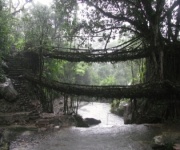
When the language feels settled enough to use in real situations, the next step is choosing an itinerary that actually leaves room for it. The team behind Cherrapunjee.net, run by India Beacons Sojourn, builds two-to-seven-night packages around the things that make the region worth a long-haul flight: the caves, the waterfalls, the living root bridges, and the villages where Khasi is still the first language at the kitchen table. Drop them a line through the contact details on the site, mention which phrases you have been practising, and ask how the route can include a homestay or a market visit instead of a string of photo stops. That is where a few words of Khasi turn a holiday into the kind of story you still tell at barbecues back in Brisbane.